
History
Two paddles.
Pong began as a warm-up exercise and became an industry. Its real invention was not the game but the feeling of a hand turning a dial and a screen answering, and the business has been arguing over who controls that feeling ever since.
Written by CONTROL
This article runs 1,144 words and takes about five minutes to read.
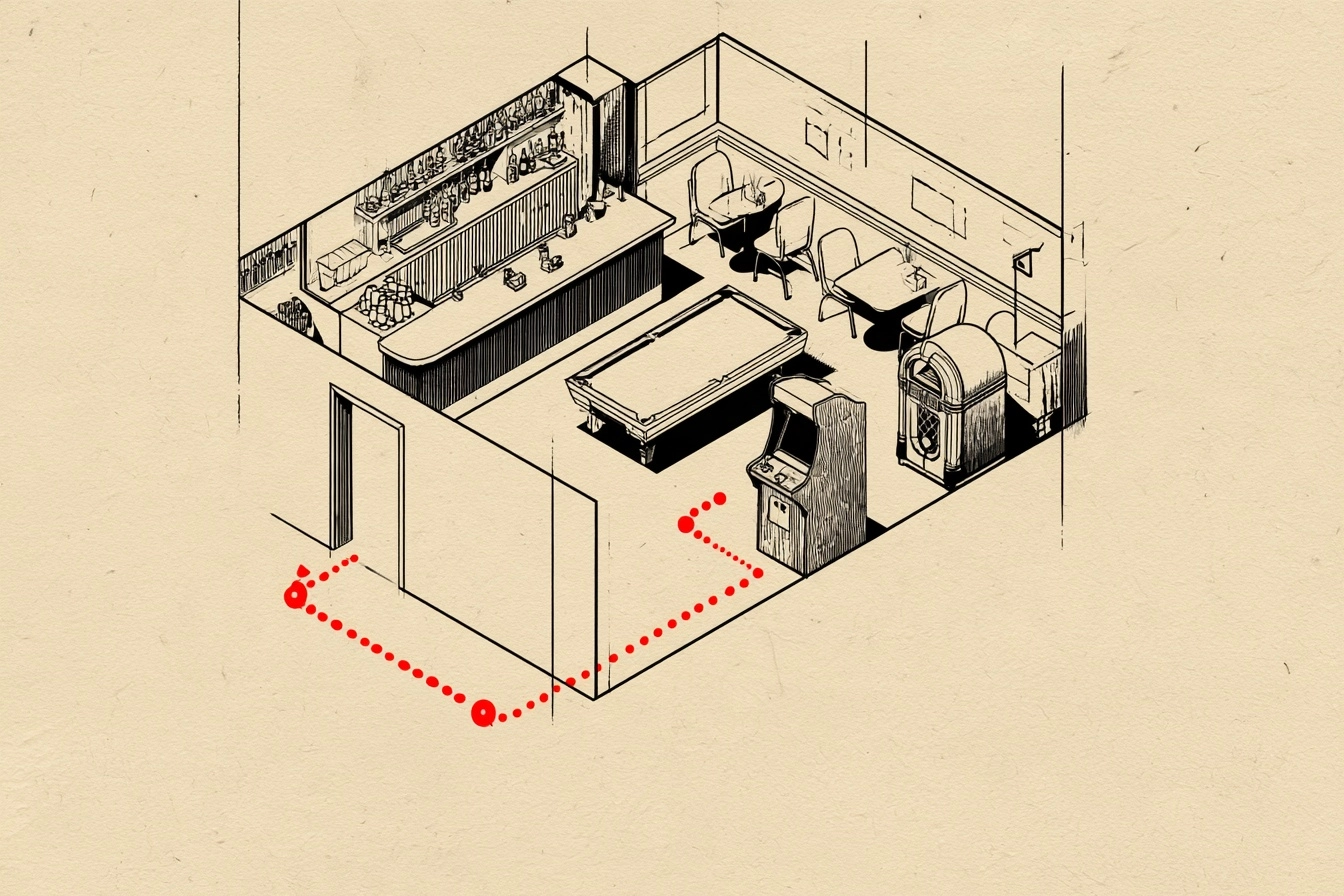
In August 1972, Nolan Bushnell and Allan Alcorn carried a wooden cabinet into Andy Capp’s Tavern, a bar in Sunnyvale, California, and left it among the pinball machines. Inside was a black-and-white television. On the front were a coin slot and two knobs. The instructions on the cabinet ran to a single line, “Avoid missing ball for high score,” and that turned out to be more than anyone needed. The machine did well on its first night and better every night after. About two weeks later the bar called to say it was broken. Alcorn drove over and found the fault. The coin box, a milk carton, was jammed with quarters.
The story has been told so often that it has the polish of a parable, and like most parables it is usually told for the wrong reason. It is offered as proof that a good idea finds its market. Pong was not a new idea, and its maker would eventually pay $1.5 million to settle the point. What it proved was stranger and has lasted longer: that people would pay, again and again, for the sensation of turning a knob and watching something on a screen answer.
A job for a client who did not exist
Bushnell and his partner, Ted Dabney, had already built one coin-operated video game, Computer Space, for another company. It was handsome and hard to learn, and it did poorly in the working-class bars where coin machines earned their keep. Bushnell later admitted it was “a little too complicated” for the man with a beer in his hand. The two went out on their own as Syzygy Engineering, each putting in $250, and on June 27, 1972, they incorporated as Atari, a term from the board game Go for a stone or group of stones about to be captured.
Earlier that spring, in May, Bushnell had gone to a Magnavox sales event in Burlingame, California, and played the table tennis game on the new Magnavox Odyssey. He was not impressed. Back at Atari he gave a newly hired engineer, Alcorn, a warm-up assignment: a simple game with one moving spot, two paddles and digits for keeping score. To make the exercise feel serious, he told Alcorn it was for a contract with General Electric. There was no such contract. Bushnell wanted to see what his engineer could do.
Alcorn did more than he was asked. He divided each paddle into eight segments, so that the ball came off at a different angle depending on where it struck, which turned a test of reflexes into a game of placement. He made the ball speed up the longer a rally lasted and drop back to its starting pace after a miss, so that every point built toward its own small crisis. When the game needed sound, he found that the circuit already drawing the picture could produce tones, and he used those. That is where the blip comes from.
None of this was invention in the patent sense. All of it was feel. The segmented paddle and the quickening ball are the difference between a demonstration and something a stranger will feed a second quarter, and designers now call that quality game feel. It remains the hardest thing in the medium to fake.
The quarters in the milk carton
After the tavern, Bushnell took the game to Chicago to show executives at Bally and Midway, and then decided that Atari would make more money building Pong than licensing it. The first factory cabinets came together at about ten a day, and many failed testing. Pong went on sale on November 29, 1972. By 1973 Atari had filled 2,500 orders, and by the end of 1974 it had sold more than 8,000 machines.
Magnavox, whose Odyssey Bushnell had played in Burlingame, sued over the idea. In June 1976 Atari settled out of court for $1.5 million, paid in eight installments. It was the most expensive game of table tennis in American business, and it established something the industry has never stopped relearning, which is that the person who has an idea first rarely owns what the idea becomes.
What it proved was stranger and has lasted longer: that people would pay, again and again, for the sensation of turning a knob and watching something on a screen answer.
A machine that could do one thing
The fights that followed were not really about tennis. They were about the box. Atari’s first consumer product, Home Pong, went on sale through Sears in 1975, and about 150,000 units went out that holiday season. Home Pong played Pong. It could play nothing else, and once the novelty wore off, the only way to sell a customer a new game was to sell him a new machine.
The way out was the cartridge. Atari developed a programmable console under the codename Stella and released it in September 1977 as the Video Computer System. It had 128 bytes of memory, which is less than this sentence. By then Warner Communications owned Atari, having bought it in November 1976 for $28 million, and Bushnell left in late 1978 after clashing with the new management. The console was renamed the Atari 2600 in November 1982, and it sold about 30 million units before production ended in 1992.
Pong came along for the ride. Video Olympics, one of the console’s nine launch titles, packed 50 games and variations onto one cartridge, most of them versions of Pong along with basketball, volleyball and hockey. It used the paddle controllers, the same kind of dial that had stood on the bar in Sunnyvale, and it let up to four people play at once.
What the dial knew
It is worth holding one of those paddles now, because the dial explains Pong better than any history can. Turn it a little and the paddle moves a little. Turn it quickly and the paddle arrives quickly. There is nothing to learn and nothing between the hand and the screen, and for a few minutes the player has something rare, which is complete command of a small world whose rules are entirely visible.
Almost everything the industry built afterward made that world larger and that command less complete. The cartridge brought variety, and the companies that controlled the cartridge came to control what the player could choose. Scores, levels and, much later, accounts and updates each added something to the experience, and each added another party to the transaction. Pong had two parties, or three if you count the machine, and the machine played it straight.
Alcorn built it as a test for a client who did not exist. The real test turned out to be whether a stranger in a bar would understand it without being told, and more than fifty years later, it is still the right one.