
Field Notes
The first cup.
Most bad coffee comes from guessing, not from bad beans. A scale, a burr grinder and a paper filter first registered in 1908 turn the first decision of the day into one you actually make.
Written by CONTROL
This article runs 968 words and takes about four minutes to read.
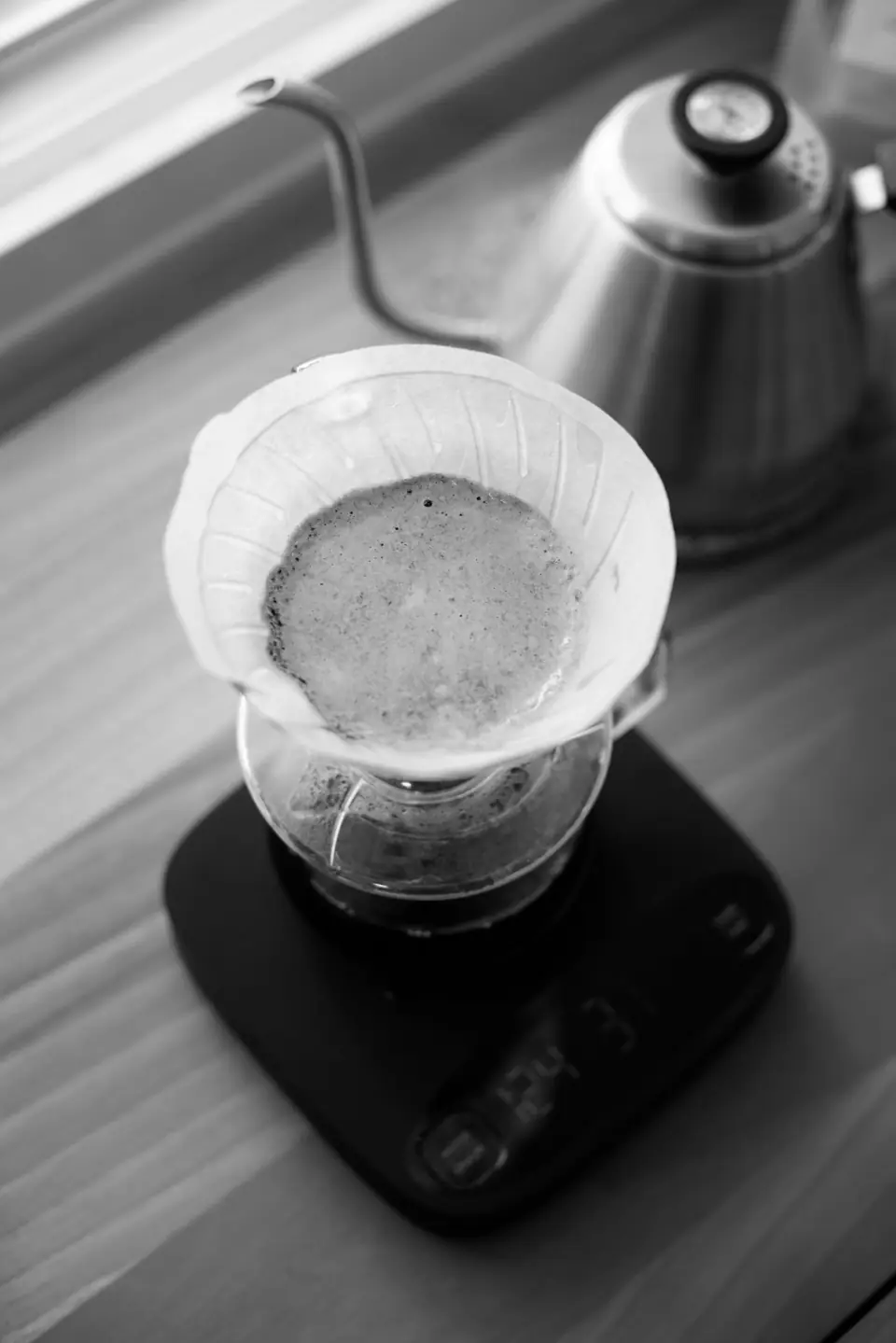
The first cup of the day is usually the least considered thing a person consumes. It is made half awake from a heaped scoop of stale, pre-ground coffee and water from a kettle that is either still boiling or long past it, and then it is judged, unfairly, as the fault of the beans. Most bad coffee is not a problem of ingredients. It is a problem of guessing. Replace the guesses with a scale and a thermometer, and an ordinary bag of fresh beans will beat most cups sold over a counter. The method here uses a pour-over cone, because it is cheap, simple and honest about what went wrong.
An invention from a Dresden kitchen
The paper filter at the center of this method has a precise origin. In Dresden, Melitta Bentz grew tired of coffee full of grounds, took a perforated brass cup and lined it with a sheet of blotting paper from her son’s exercise book. On June 20, 1908, the Imperial Patent Office in Berlin registered her filter as a utility model, and that December she founded a company from a room in the family’s apartment with 72 pfennigs in capital. The company still carries her first name. Her insight was not about flavor so much as control: separate the grounds from the cup, and the brew becomes something you can repeat.
The tools and the numbers
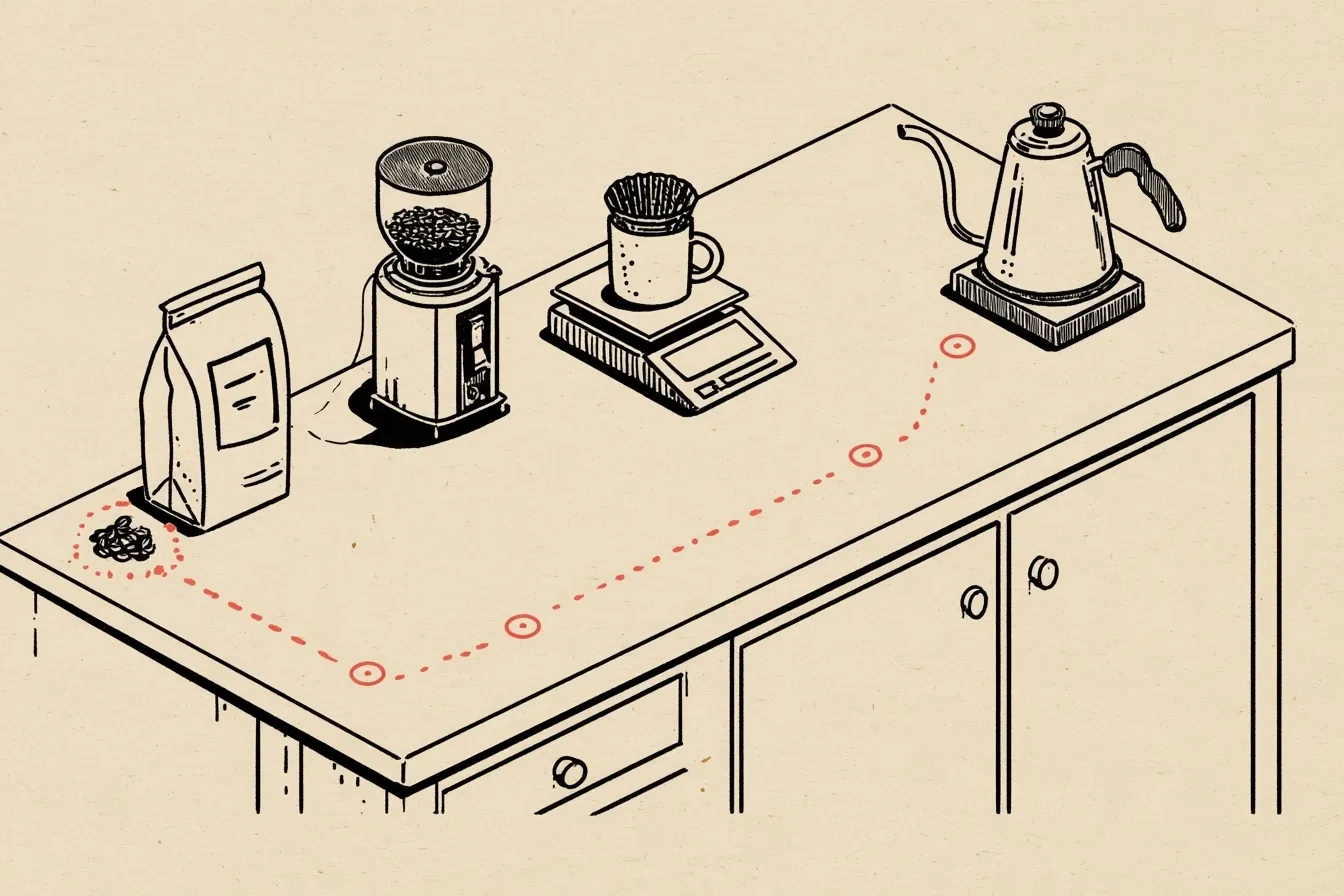
You need a burr grinder, a digital kitchen scale that reads single grams, a pour-over cone with paper filters and a kettle. A burr grinder crushes beans between two rings to an even size, while a blade grinder chops them into a mix of dust and boulders that brews unevenly, so the grinder is where the money should go first. A gooseneck kettle, with its thin spout, lets you pour slowly and exactly, and a model with a temperature setting removes one more guess.
Buy whole beans from a roaster that prints a roast date on the bag, and brew them within about a month of that date. Keep them in an airtight, opaque container at room temperature, and grind only what you need just before brewing, because ground coffee goes flat quickly.
The Specialty Coffee Association’s Golden Cup standard uses 55 grams of coffee per liter of water as its reference strength, which is close to one part coffee to eighteen parts water. For one large mug, that works out to about 18 grams of coffee and 330 grams of water. If you want it stronger, move toward one to sixteen, and if you want it lighter, move toward one to nineteen. The same standard puts the water between 195°F and 205°F where it meets the coffee, and 200°F, or 93°C, sits in the middle. Without a thermometer, bring the kettle to a boil and let it rest off the heat for thirty seconds.
Four minutes at the counter
Put the filter in the cone, rinse it with hot water to wash out the paper taste and pour that water away. Grind 18 grams of coffee to the texture of coarse sand, tip it in and shake the cone gently so the bed lies flat. Set everything on the scale and press tare.
Start a timer and pour about 40 grams of water, enough to wet every ground, then wait 30 to 45 seconds while the coffee bubbles and swells. This is the bloom, and it lets trapped carbon dioxide escape so the water can reach the coffee evenly. Then pour slowly in small circles, keeping the water in the cone steady, until the scale reads 330 grams at about the two-minute mark. The water should finish draining between three and four minutes.
Your tongue is the diagnostic tool, and there are only two readings to learn. If the coffee tastes sour, thin or sharp, the water did not pull enough out of the grounds, so grind finer next time. If it tastes bitter, harsh or dry, the water pulled too much, so grind coarser. Change the grind one step at a time and keep the dose, the water and the temperature fixed, or you will never know which change did the work.
Sour means grind finer, and bitter means grind coarser.
Sour means grind finer, and bitter means grind coarser. Those two rules are worth more than any new piece of equipment.
How much, and how late
Control over coffee includes control over how much of it you drink. The Food and Drug Administration says that 400 milligrams of caffeine a day, about two to three 12-ounce cups of coffee, is not generally associated with negative effects in most adults, though it notes that sensitivity varies from person to person. Some people feel jittery or sleepless on far less. Timing matters as much as quantity. In a 2013 study in the Journal of Clinical Sleep Medicine, 400 milligrams taken six hours before bed still cut measured sleep by more than an hour, and the volunteers mostly did not notice. For most schedules, that argues for drinking the good cups in the morning and stopping by early afternoon.
The recipe is easy to follow on a Sunday. It is harder on a Tuesday at 6:45, when the scale seems like a step to skip. Set the station up the night before, with the cone on the mug, a filter in place, the beans weighed in the grinder and the kettle filled, so the morning job is one button and four minutes of pouring. Tape the recipe inside the cabinet door, with the dose, the water, the temperature and the grind setting. Once the method runs without thought, attention is free for the beans, which is where the real pleasure is, and the first decision of the day is finally one you made on purpose.