
Reported
The quiet car.
Noise is now treated by health agencies as a pollutant that shortens lives, and silence has become something people buy. The most successful answer so far came from commuters on an early train who simply asked for one car without phones.
Written by CONTROL
This article runs 1,125 words and takes about five minutes to read.
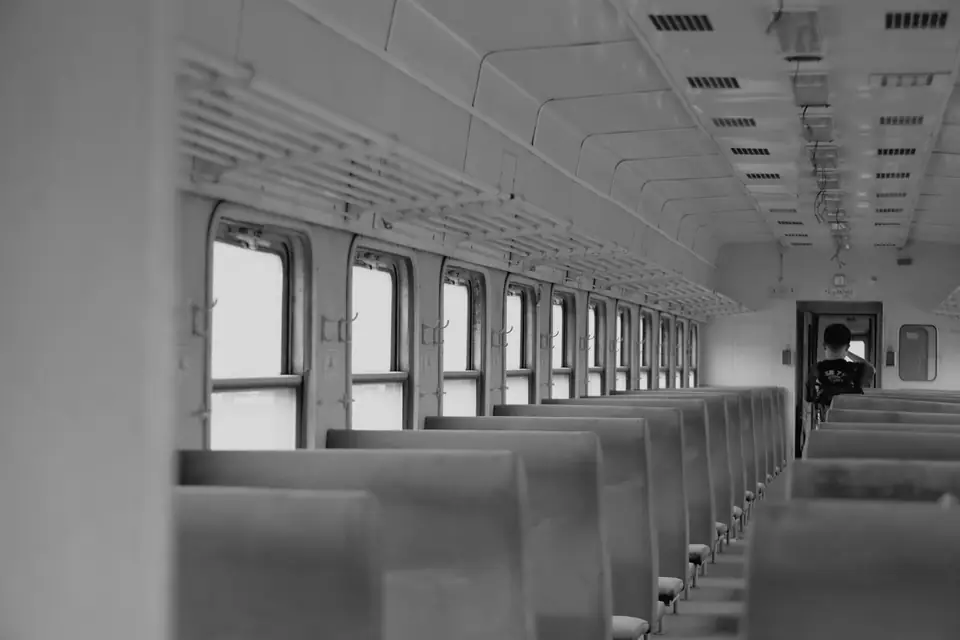
Around the turn of 2000, a group of regular commuters on Amtrak’s early-morning train from Philadelphia to Washington made a modest request. They wanted one car where nobody talked on a cellphone. The railroad agreed to try it and designated a single coach as the Quiet Car. By the spring of 2001, according to the trade journal Progressive Railroading, Amtrak had put Quiet Cars on 25 trains.
Today the Quiet Car runs on the Acela, the Northeast Regional, the Keystone and a handful of other routes. The rules ask passengers to speak in subdued tones, forbid phone calls and require headphones for any device that makes noise, at a volume nobody else can hear. The lighting is kept low. It costs nothing extra. It is one of the few amenities anywhere that consists entirely of the absence of something.
The Quiet Car is a small idea, but it answers a large question: what happens when silence, which used to be the default condition of most places, becomes scarce enough that people have to ask for it?
A pollutant with a body count
For most of the twentieth century, noise was treated as a nuisance, a matter for neighbors and local ordinances. That view has changed. In 2018 the World Health Organization’s Regional Office for Europe published its Environmental Noise Guidelines, which set health-based limits for the sounds of modern life. For road traffic, the WHO recommended keeping average exposure below 53 decibels over the day, evening and night, and below 45 decibels at night. For railways the figures were 54 and 44, and for aircraft, 45 and 40.
The reason for the precision is that the harm is measurable. The European Environment Agency estimates that at least one in five people in the European Union live with long-term noise levels considered harmful to health, mostly from road traffic. It attributes about 66,000 premature deaths a year and 50,000 new cases of cardiovascular disease to long-term exposure to transport noise. The mechanism is not mysterious. Noise disturbs sleep, raises stress hormones and blood pressure, and does so even when the sleeper does not fully wake. The body hears the city all night, whether the mind registers it or not.
The United States has no equivalent national accounting, and it has largely left noise to cities. In New York, noise has long been among the most common complaints to the city’s 311 line. The complaints are about car alarms, construction, late-night bars, leaf blowers and helicopters, and they arrive by the hundreds of thousands each year. They are also a record of who has the least control over their environment, since exposure tends to be worst near highways, airports and rail yards, where housing is cheaper.
The sound of your own nervous system
Silence, in the strict sense, does not exist, and the most famous demonstration of that came from a composer. In 1951 John Cage visited the anechoic chamber at Harvard University, a room engineered to absorb all sound, expecting to hear nothing. He heard two sounds, one high and one low, and an engineer told him they were his nervous system and his blood. The experience led to 4′33″, first performed by the pianist David Tudor in Woodstock, New York, in August 1952, in which a performer plays nothing and the audience hears the room.
Cage’s point is useful for anyone pursuing quiet. Silence is not zero. It is the condition in which the sounds you hear are small, unforced and chosen, rather than imposed by engines, machines and other people’s phones. What a city takes away is not silence as such but control over the acoustic environment. The Quiet Car restores that control for the length of a trip.
The market has noticed the scarcity. Noise-canceling headphones, once sold mainly to airline passengers, are now an ordinary sight on city sidewalks, and they work by listening to the world and playing its inverse back into the ear. They are a real comfort, and they are also a private solution to a public problem. A person wearing them has not made the street any quieter; he has built a smaller room inside it, and the room runs on a battery. The Quiet Car does something different. It asks a group of strangers to agree, for an hour or two, on a shared standard of consideration, and it works because nearly everyone keeps the agreement.
Why quiet is hard to sit in
There is an uncomfortable complication. Many people claim to want silence and then cannot stand it. In a series of experiments published in Science in 2014, the psychologist Timothy Wilson and colleagues at the University of Virginia and Harvard asked people to sit alone with their thoughts for a short period, usually between six and fifteen minutes. Most found it unpleasant. In one experiment, participants were given the option of administering a mild electric shock to themselves during the waiting period, having previously said they would pay to avoid it. About two-thirds of the men and a quarter of the women pressed the button at least once.
The finding echoes a much older observation. Blaise Pascal wrote in the seventeenth century that a great deal of human trouble comes from our inability to sit quietly in a room alone. The smartphone did not create that difficulty; it monetized it. Every silent interval in a modern day, in the elevator, in line, at a red light, is now an opportunity for a screen to fill. The feed is, among other things, an efficient machine for preventing silence.
The feed is, among other things, an efficient machine for preventing silence.
Asking for the car
This is why the Quiet Car matters more than its size suggests. It did not come from an engineer, a regulator or a wellness brand. It came from ordinary commuters who noticed that something had been taken from them and asked, politely, for a small part of it back. The railroad discovered that people valued the arrangement, and that it would enforce itself; regulars in the Quiet Car have a reputation for enforcing the rules themselves.
The lesson for a noisy life is similar. Silence rarely arrives on its own anymore. It has to be designed, requested and defended: a phone left in another room, a bedroom window that closes properly, a walk without earbuds, an hour in a library, a commute spent reading. None of these is heroic. Each is a decision to let the small sounds, including the ones your own body makes, reach you without competition. The city will not provide that on its own. But as a handful of commuters on an early train discovered, you can often get it simply by asking for the car.