
History
The console war.
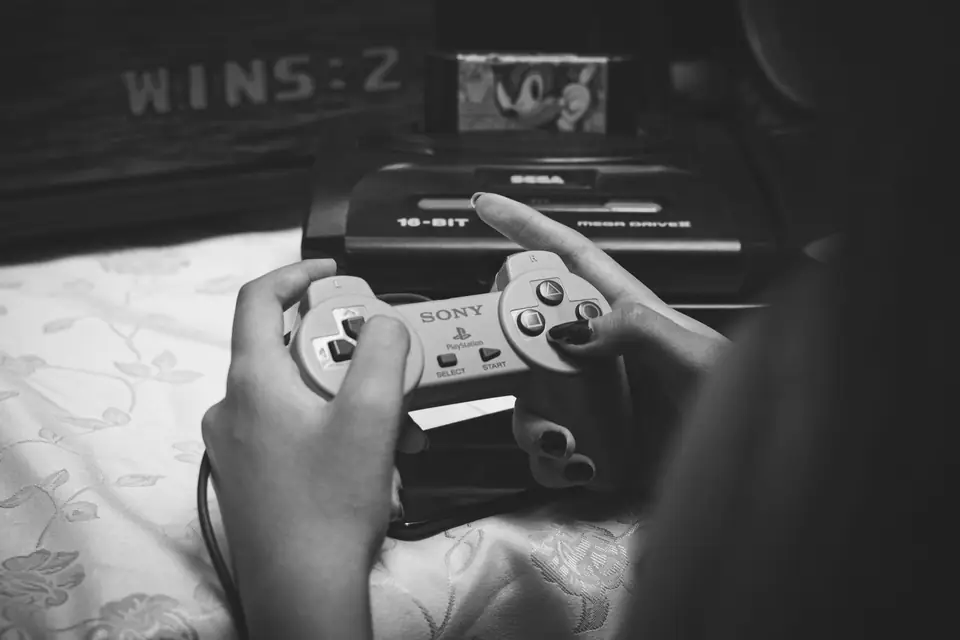
From 1989 to the mid-1990s, Sega and Nintendo fought for every American living room with a hedgehog, a plumber and a great deal of advertising. It was the first time a technology rivalry was sold to children as a question of identity, and the method outlived both armies.
Written by CONTROL
This article runs 969 words and takes about four minutes to read.
If you were a child in the early 1990s, you probably picked a side, and you may still believe you picked right. The fight between Sega and Nintendo was, in commercial terms, an argument about 16-bit processors and retail prices. In the schoolyard it was something else: a question about who you were. That shift, from product to allegiance, is the real legacy of the console war, and it is worth understanding how deliberately it was made.
The challenger lands
Sega brought the Genesis to America in August 1989, first to stores in New York and Los Angeles, at $189.99. Nintendo still owned the market with the NES, which it had launched in America in 1985. Michael Katz, the new chief executive of Sega of America, went straight at the giant with a slogan built for the playground: “Genesis does what Nintendon’t.” The ads worked on the children, but the NES kept selling.
The slogan is more interesting than it first appears. It did not say what the Genesis did. It said only that the other machine could not, and it invited the buyer to finish the thought. Nintendo had spent four years building a reputation as the safe, reliable choice. Sega’s opening move was to recast that reputation as a weakness, and to suggest that choosing the dominant console was a little bit childish.
The toy man
In 1990 Sega hired Tom Kalinske as president and chief executive of Sega of America. He had spent fifteen years at Mattel, where he helped revive Barbie, launched Masters of the Universe and rose to chief executive. He understood something that engineers did not, which was that children bought characters and attitudes, not specifications. He cut the price of the Genesis, aimed the advertising at older children and teenagers, and made one decision that changed the war. He wanted the console bundled with Sega’s newest game in place of Altered Beast.
That game was Sonic the Hedgehog, built by Sonic Team under programmer Yuji Naka and character designer Naoto Ohshima. It reached America in June 1991, and that November Sega began putting it in the box. The Super Nintendo had arrived on August 23, 1991, at $199, with Super Mario World as its pack-in. In the last three months of 1991, the Genesis outsold the Super Nintendo two to one, and by January 1992 Sega held 65 percent of the 16-bit market. It was the first time since 1985 that Nintendo had lost the lead.
A smaller company cannot outspend the giant, so it has to be faster, louder and cheaper in the one place that counts.
The language of the fight
Kalinske’s Sega grasped the challenger’s basic position. A smaller company cannot outspend the giant, so it has to be faster, louder and cheaper in the one place that counts. Sonic was faster than Mario by design, and the advertising made speed into a personality. Later campaigns promised “blast processing,” a phrase meant to suggest that the Genesis thought faster than its rival. It referred to an obscure graphics programming method that games did not actually use. The phrase was pure marketing, and it worked on a generation of children who could not have explained it and did not need to.
This is the part of the war that deserves a harder look. Neither company invented comparative advertising, and neither was doing anything unusual by the standards of the toy business. But the console war taught millions of young customers to treat a purchase as a team to defend. The arguments on the school bus were not really about frame rates. They were about loyalty, and loyalty is among the most valuable things a company can own, because a loyal customer does the marketing for free.
Who actually won
Nintendo’s answer was patience and a deeper library. Sega won the early rounds on attitude and price, but Nintendo kept publishing games that sold for years, and it kept its hold on Japan. The final count favors Nintendo. The Super Nintendo sold 49.10 million units worldwide, 23.35 million of them in North America, while Sega sold 30.75 million Genesis consoles. A 2014 analysis by Wedbush Securities found that the Super Nintendo outsold the Genesis in the United States by 1.5 million units, which means the American war was much closer than the worldwide one.
Nintendo won on sales, and Sega changed the way games were sold. Kalinske took Sega of America from $72 million in revenue to more than $1.5 billion, and he forced Nintendo to fight for a market it had once simply owned. Then both companies lost ground to a third one. In September 1995 Sony brought the PlayStation to America, and the next war was fought on disc, with a company that had watched the first one closely.
The armistice on a menu screen
The strangest coda is how peacefully it ended. Sega eventually stopped making consoles and began publishing its games on other companies’ machines, including Nintendo’s. Today a Nintendo Switch Online membership with the Expansion Pack includes a library of Sega Genesis games alongside the Super Nintendo collection, so the two armies now sit on the same menu, one button apart.
The allegiances outlived the war that created them, and the method spread everywhere. Phones, sneakers, streaming services and cars are now sold with the same promise that the Genesis made in 1989: that the choice says something about you, and that the people who chose otherwise are missing something. The children who argued on the bus grew up into adults who can recognize the technique. The useful habit is to notice when a purchase is being offered as an identity, and to remember that the companies on both sides of that argument were, from the start, on the same side of the counter.