
The Long Read
Handing over the controller.
The generation that grew up alone with a console is now playing beside its children. The research on co-play is modest but consistent, and it suggests that the game matters less than the person sitting on the couch.
Written by CONTROL
This article runs 1,343 words and takes about six minutes to read.
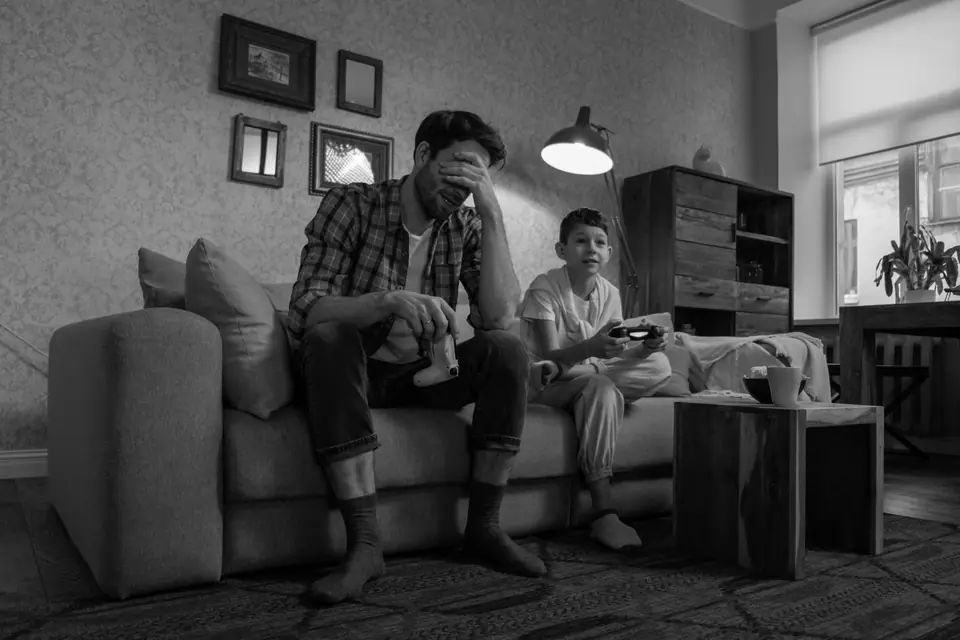
There is a particular sound a child makes when a parent dies in a video game. It is not quite laughter. It is closer to the noise of someone watching a grown-up discover that the world has rules he does not understand, and it is one of the few moments in family life when the ordinary arrangement of authority is reversed. The adult asks how to jump. The child shows him. For a few minutes the person who usually holds the car keys, the passwords and the final word is the least competent person in the room.
The parents of the current generation of children are, for the first time, people who grew up with a controller. Many of them learned to play alone, or with a brother, while their own parents watched from the doorway or did not watch at all. Now they are on the other side of the couch, and a surprising number of them have decided to pick up the second controller rather than set a timer. It is worth asking what the research says about that choice, and what a parent is actually handing over along with the hardware.
What the studies found
The best-known study is a small one. In 2011, Sarah Coyne and Laura Padilla-Walker of Brigham Young University and their colleagues published a paper in the Journal of Adolescent Health with the title “Game On… Girls.” They surveyed 287 families with children between eleven and sixteen and asked how often parents played video games with them. For girls, playing with a parent was associated with lower levels of aggression and of internalizing problems such as anxiety and withdrawal, with more prosocial behavior, and, marginally, with a stronger sense of connection to the parent. For boys, co-play was not significantly related to any of the outcomes, good or bad.
The authors’ explanation for the difference was practical rather than psychological. Boys in the sample played far more on their own and with friends, so an hour with a parent was a small share of their gaming life. For girls it was a larger share, and it tended to happen with age-appropriate games. Coyne’s advice to parents was characteristically plain: “If your daughter is really into gaming don’t be afraid to give it a go.” The pattern in her data matches what the Pew Research Center found more than a decade later. In a 2023 survey of American teenagers, 97 percent of boys said they played video games, compared with 75 percent of girls, and 61 percent of boys played every day, against 22 percent of girls.
A 2013 review of the literature by Anneliese Sheffield and Lin Lin of the University of North Texas collected the other findings. Parents and children both reported feeling more connected when they played together. Regular co-play between fathers and children was linked to better family functioning. At the same time, only about a third of adolescents in one study they cited said they had ever played a video game with a parent, and parents in another survey reported playing more often with sons than with daughters, which is the reverse of where Coyne found the benefit to be largest.
None of this is proof that playing Mario Kart on Sunday afternoon will produce a well-adjusted teenager. The studies are correlational, and the kind of parent who sits down to play is probably the kind who does a great many other things right. But the direction of the evidence is consistent, and it points away from the familiar framing of games as a problem to be rationed and toward a different idea, one that researchers at the Joan Ganz Cooney Center called joint media engagement in a 2011 report, The New Coviewing. The point is not the medium. It is whether an adult is in it with the child.
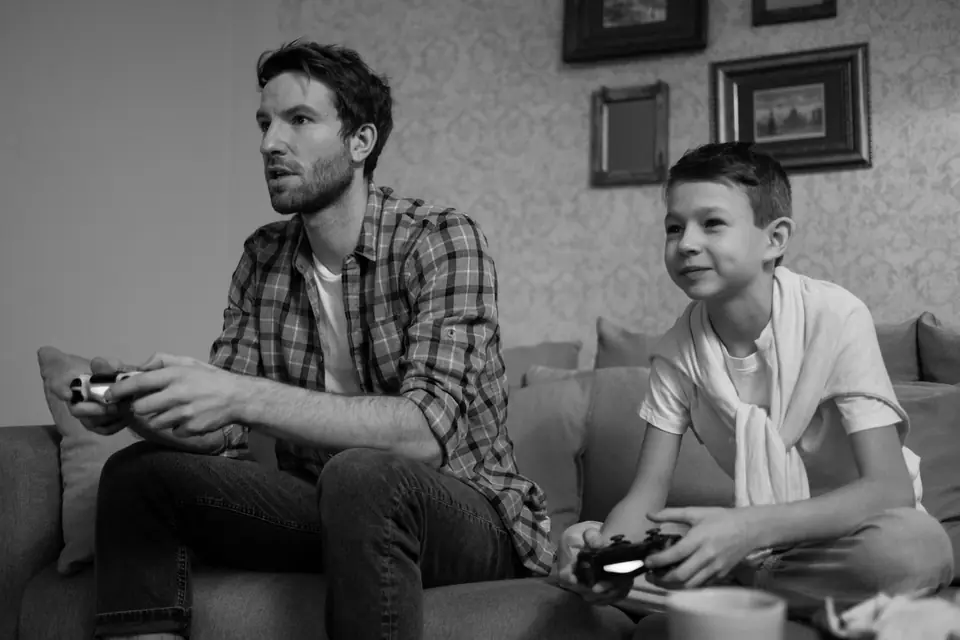
The adult asks how to jump. The child shows him.
Designed for two
Game designers have noticed the couch too. When Nintendo made Super Mario Galaxy for the Wii in 2007, its president, Satoru Iwata, wanted the game to appeal to less experienced players, and the team added a Co-Star mode in which a second person, holding only a Wii Remote, could collect Star Bits, freeze enemies and help Mario jump. It was a role built for the parent who could not quite manage a platform game, or for the small child who could not yet. Super Mario Odyssey, released for the Switch in 2017, did something similar by letting the second player control Mario’s hat.
These modes matter because they solve the oldest problem in family play, which is the gap in skill. A father who is good at a game and a daughter who is new to it cannot play as equals, and a game that pretends otherwise ends in tears or in a condescending loss. Asymmetric roles let both people contribute. They also teach something that the solo game rarely does: that a task can be shared unevenly and still belong to both people.
The console in the closet
Then there is the matter of the old hardware. When Nintendo released the NES Classic Edition in November 2016, a small replica of its 1985 console with thirty built-in games at $59.99, it sold out almost immediately, and by the end of June 2018 Nintendo had sold 3.6 million units. Some of those buyers were collectors. Many were parents in their thirties who wanted their children to play the games they had played, on something that looked like the machine they remembered. Nintendo’s subscription service has offered a library of NES games on the Switch since 2018 for the same reason.
Handing a child an eight-bit game is a strange gift, and a revealing one. The graphics are crude, there is no tutorial and the games are hard in a way modern design has mostly abandoned. A child raised on games that forgive every mistake meets one that does not. The parent who passes it down is passing down a set of values as much as a piece of software: patience, repetition, the idea that a difficult thing can be learned by doing it badly many times. He is also passing down a piece of his own childhood, which is why the gesture can feel more tender than its price suggests.
Mothers are part of this story, though the popular image of the gaming parent is almost always a father. Many women in their thirties and forties grew up with the same consoles, and Coyne’s finding about daughters suggests that a mother who plays may be especially well placed to make the time count. The couch has room for both.
What gets handed over
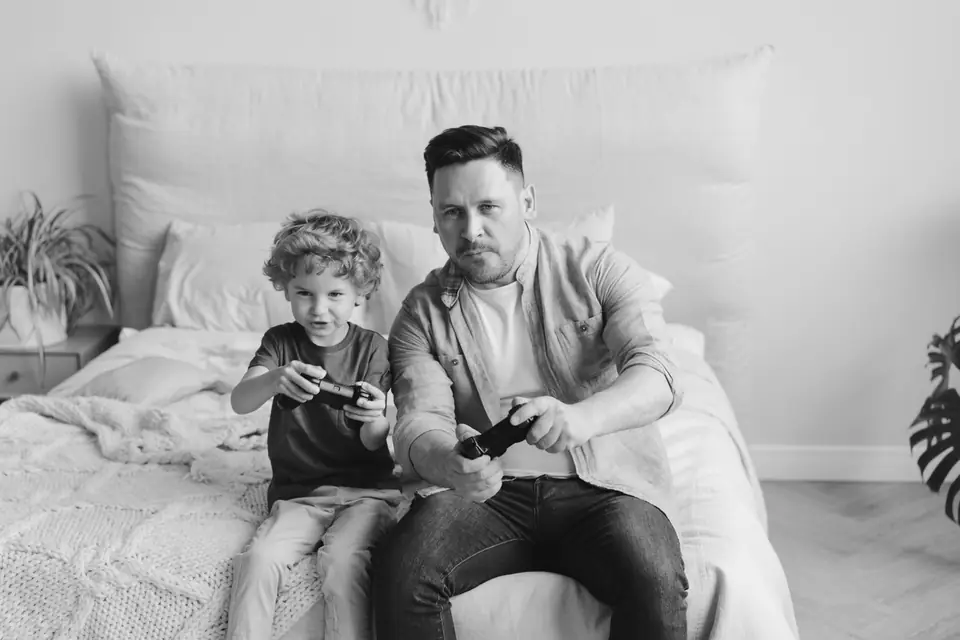
A controller is a device for giving someone agency inside a small world. When a parent hands one to a child, he is making a choice about how much of that agency to share. He can play the game for the child, which is quicker and teaches nothing. He can leave the child alone with it, which is easier and leaves the child alone. Or he can sit beside her and let her fail, offering a hint only when she asks for one.
The third option is slower and less efficient than the others, and it is the one the research keeps finding value in. It resembles, not by accident, how a parent teaches a child to ride a bicycle or cook an egg. The skill is transferred, but so is something else: the experience of being accompanied while learning, of having someone older watch you struggle without taking over.
Eventually the child becomes better at the game than the parent, usually sooner than the parent expects. That moment is worth noticing. A controller handed down well is handed down for good, and the parent who once explained how to jump ends up on the couch asking for help with the second level. It is a small preview of the larger handover still to come, and it is a gentle way to practice it.