
History
Midway.
For half a century a company from the Chicago suburbs put its name on many of the biggest cabinets in American arcades, and most of those games were invented somewhere else. Midway’s story shows how much of a hit can be rented, and what is left when the lease runs out.
Written by CONTROL
This article runs 1,015 words and takes about four minutes to read.
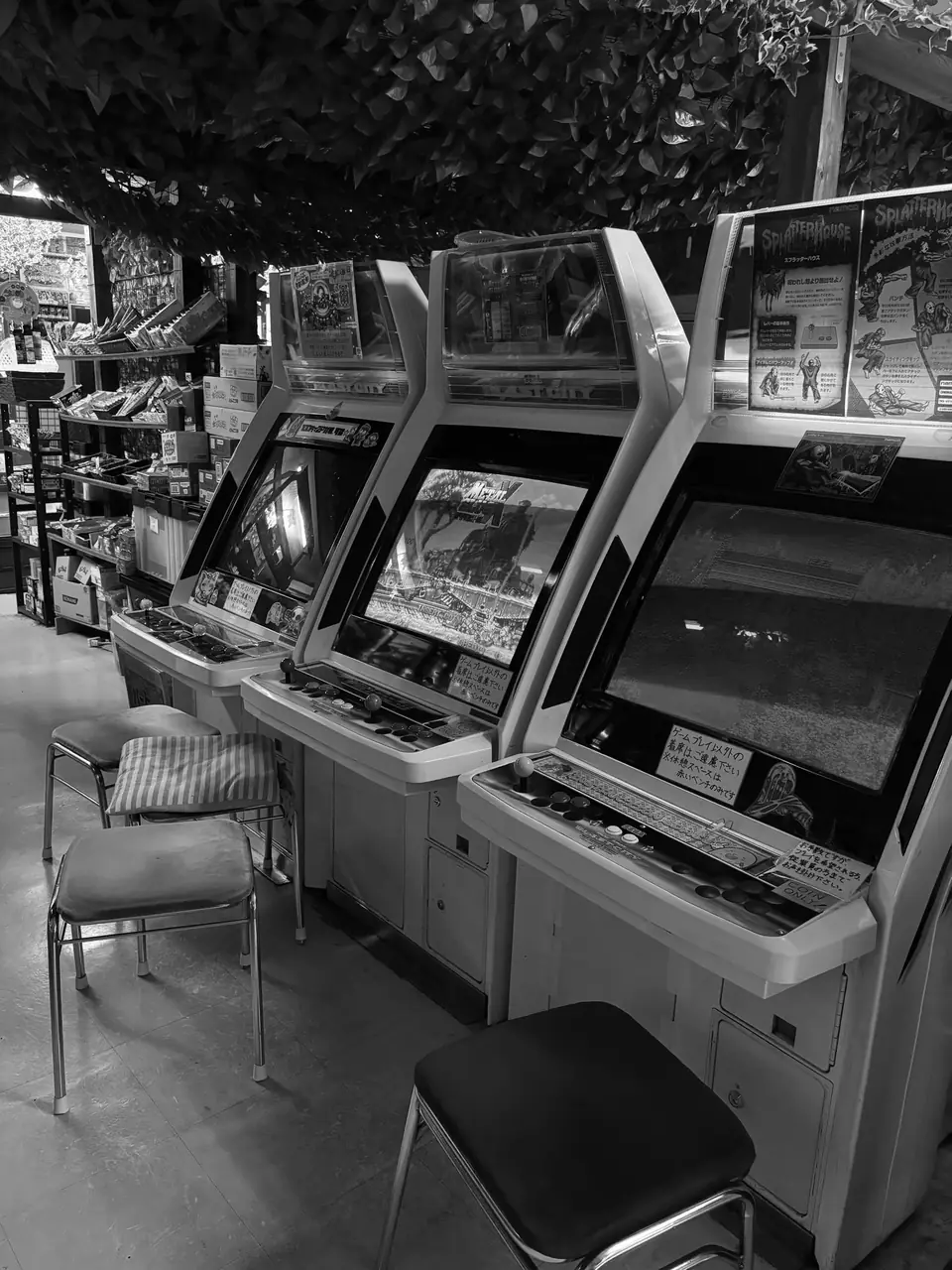
Stand in an American arcade in 1982 and look at the three machines with the longest lines. One is Space Invaders, designed in Tokyo at Taito. One is Pac-Man, designed in Tokyo at Namco. The third is Ms. Pac-Man, built in Massachusetts by a small company called General Computer Corporation. All three cabinets carry the same name, and it belongs to none of the people who made the games. It is Midway, a manufacturer from the suburbs of Chicago that had a better eye for other people’s work than almost anyone in the business.
For about twenty years that eye was enough. Then the arcade began to disappear, and Midway discovered what every middleman eventually learns: a license is a lease, and the only thing a company truly owns is what its own people make. The story of Midway is the story of the American arcade, and it ends with a single character carried out of the wreckage.
A pinball town
Henry Ross and Marcine Wolverton founded Midway Manufacturing in 1958 as an independent maker of amusement equipment in Schiller Park, Illinois. Chicago and its suburbs were the capital of the coin-operated business, home to the pinball and slot-machine makers alike, and a new company there learned the trade by building cabinets that made money one coin at a time. In 1969 Bally Manufacturing, then a leader in slot machines, bought Midway.
The company’s first brush with video games was a missed chance. In 1972 Nolan Bushnell brought an early Pong to Chicago to show executives at Bally and Midway, and afterward Atari decided to build the game itself. Midway did not make that mistake twice.
The importer
Its first landmark video game came from Japan. Taito’s designer Tomohiro Nishikado had made a Western duel called Western Gun, and Midway’s Dave Nutting and the programmer Tom McHugh reworked it for America. Gun Fight reached arcades in November 1975. It was the first video game to show one person shooting at another, and Midway’s version was the first arcade game built around a microprocessor, an Intel 8080, instead of hard-wired logic. Midway sold 8,600 cabinets in the United States.
Then came the run that made the name. In 1978 Midway won the American rights to Taito’s Space Invaders, the game that turned arcades into a national habit. In October 1980 it released Namco’s Pac-Man in North America, and about 400,000 Pac-Man cabinets were installed worldwide by 1982. In February 1982 it followed with Ms. Pac-Man, which it had bought from General Computer Corporation and finished with Namco. That game sold about 125,000 cabinets by 1987.
The biggest cabinets of the era were Space Invaders, Pac-Man and Ms. Pac-Man, and Midway sold all three in America. Bally folded its own pinball business into Midway during this period, and the company became Bally Midway. Its in-house designers produced hits of their own, among them Spy Hunter in November 1983, with an electronic version of Henry Mancini’s Peter Gunn theme, and Rampage in August 1986. They were good games. They were not Pac-Man, and nobody at the company could have mistaken the licensing business for the whole business.
The last great run
In 1988 Williams Electronics, Midway’s longtime pinball rival and part of WMS Industries, bought Bally Midway. The combined company produced the last great burst of American arcade games, and this time the games were its own. Mortal Kombat, made by a team of four led by Ed Boon and John Tobias, arrived in 1992 and started a national argument about violence in games. NBA Jam, led by the designer Mark Turmell, arrived in April 1993 and took in more than $1 billion worldwide in its first twelve months, most of it one quarter at a time. More than 20,000 NBA Jam cabinets shipped.
NBA Jam also left behind the best small parable about who controls a game. Players long suspected that the Chicago Bulls missed too many last-second shots, especially against the Detroit Pistons. They were right. In 2008 Turmell, a Pistons fan, confirmed that he had written code to make the Bulls miss crucial late shots against Detroit. The quarters were real and the contest looked fair, but somewhere inside the cabinet a man from Michigan had his thumb on the scale. Every player who ever lost a close one on a machine has wondered about that thumb. For once, it was there.
The quarters were real and the contest looked fair, but somewhere inside the cabinet a man from Michigan had his thumb on the scale.
What the lease left behind
WMS took Midway public in 1996 as Midway Games and spun off its remaining stake in 1998, leaving Midway an independent company. The timing was poor. The arcade business faded in the late 1990s as home consoles caught up, and Midway had to reinvent itself as a console publisher competing with far larger companies. It ranked as the fourth-largest video game publisher in 2000, but the losses kept coming. On February 12, 2009, Midway Games filed for Chapter 11 bankruptcy.
On July 1, 2009, Warner Bros. Interactive Entertainment bought most of its assets for about $33 million. The list is revealing. Space Invaders still belonged to Taito and Pac-Man to Namco, as they always had. The factory skills, the distribution network and the knowledge of how to put a heavy wooden cabinet in a pizza parlor and keep it earning were worth very little by then. What Warner paid for, above all, was Mortal Kombat, along with the Chicago studio that became NetherRealm Studios, where Ed Boon still makes the series.
It is a clean ending to a messy history. For fifty years Midway survived every change in technology by finding the best games it could and selling them better than anyone else. When the machine it knew how to sell went away, the only thing of lasting value was a fighting game its own small team had built in the suburbs, and the people who knew how to make another one.