
History
The crash.
Between 1983 and 1985 the American home video game business lost about 97 percent of its revenue. The collapse was a failure of trust, and the cure the industry chose, a gatekeeper, still decides what we are allowed to play.
Written by CONTROL
This article runs 1,065 words and takes about five minutes to read.
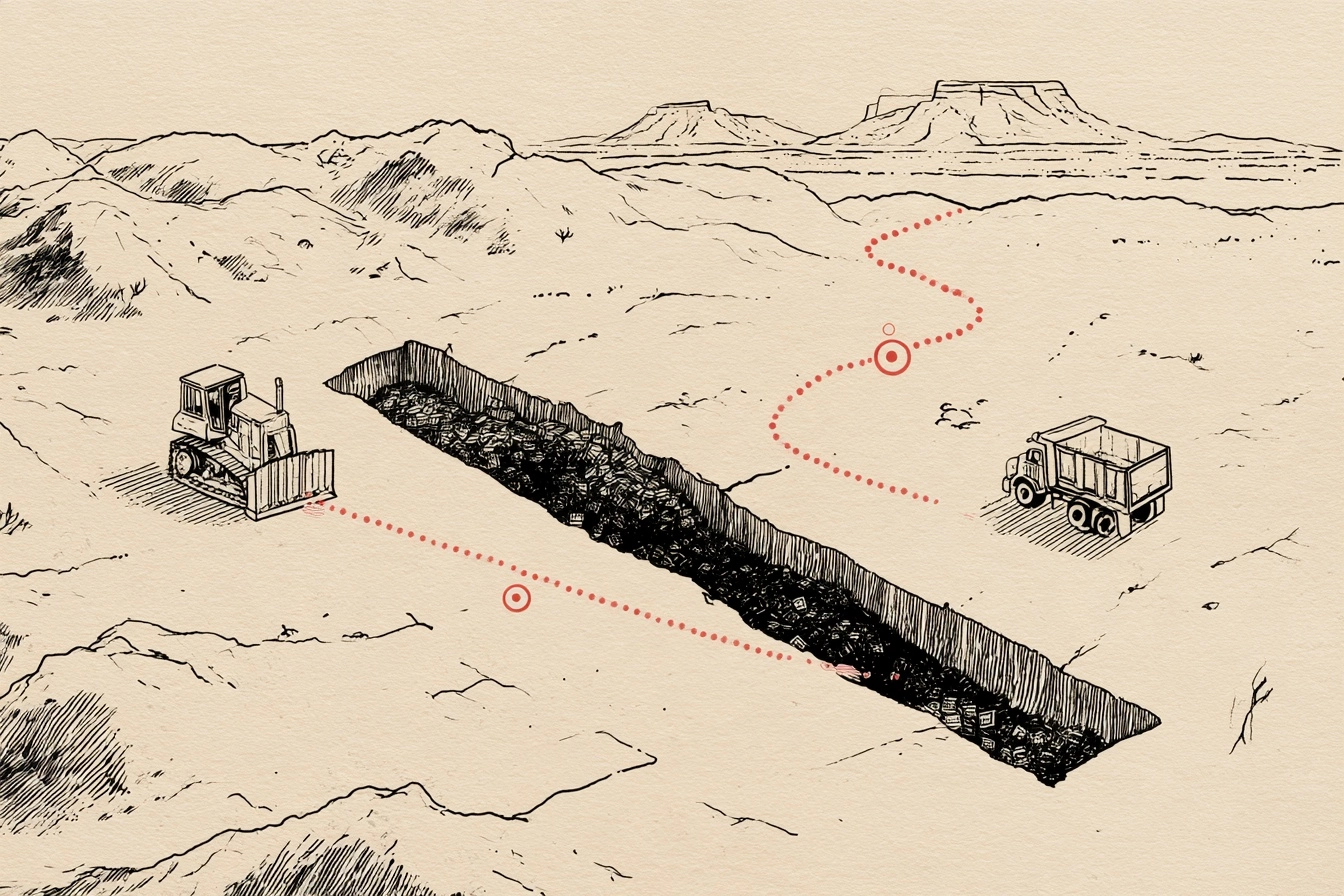
On September 26 and 27, 1983, trucks left an Atari warehouse in El Paso and drove north to the city landfill in Alamogordo, New Mexico. Between 10 and 20 semi-trailer loads of unsold cartridges, consoles and computers were crushed and buried there, and starting September 29 a layer of concrete was poured over the site. The story that grew out of those two days is the one most people know about the video game crash: that Atari made a game so bad it had to hide the evidence in the desert.
The burial happened. The rest of the story is wrong in a useful way. The landfill held the ordinary debris of a company that had made far too much of everything, and the game usually blamed for it was a symptom rather than a cause. The crash of 1983 is worth understanding correctly because its lesson was never about one bad cartridge. It was about what happens when buyers can no longer tell good from bad, and about the price they later agreed to pay to be able to tell again.

The arithmetic
In 1982 American home video game revenue stood at about $3.2 billion. By 1985 it was about $100 million, a fall of roughly 97 percent.
The first cause was simple crowding. By 1983 a buyer could choose among the Atari 2600, the Atari 5200, the Intellivision, the ColecoVision and several other machines. Each needed its own games, and stores had room for only so many boxes. A Goldman Sachs analyst later described the arithmetic: in 1983 demand grew 100 percent over the year before, while manufacturing output grew 175 percent. The difference piled up in warehouses, some of which eventually emptied into Alamogordo.
A market that could not tell
The second cause was the cartridges themselves. Activision had shown that outside companies could make money selling games for the 2600, and dozens of firms followed with little experience and less quality control. Shelves filled with games nobody wanted, and discount bins filled with the rest. When a customer could not tell a good cartridge from a bad one by looking at the box, he did the rational thing and stopped buying cartridges.
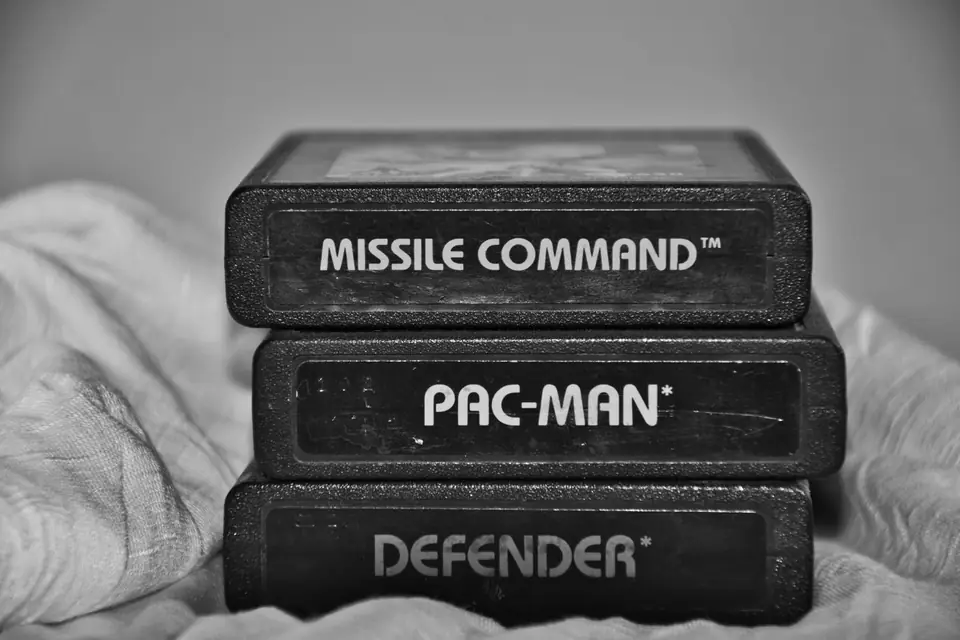
Atari did its share of the damage. Its 2600 version of Pac-Man, released in March 1982, sold more than 7 million cartridges by the end of that year, but players and critics hated its flickering ghosts and simplified maze. Then came E.T. the Extra-Terrestrial. Atari paid a reported $20 million to $25 million for the rights to the film. The designer, Howard Scott Warshaw, got the assignment on July 27, 1982, and had to finish by September 1 to make the Christmas production run, which left him just over five weeks. Atari produced about 4 million cartridges, and huge numbers came back unsold or returned.
E.T. has carried the blame ever since, which is convenient for everyone except Warshaw. A five-week deadline for a year’s work produces a five-week game, and the decision to impose it was made well above the designer. More to the point, a healthy market survives a disappointing Christmas title. This one did not, because customers had already stopped trusting the shelf.

The crash was not caused by one bad game. It was caused by a market that could no longer tell good from bad.
The computer in the next aisle
Home computers pressed from the other side. When Commodore cut the price of the Commodore 64 in 1983, a parent could reasonably ask why he should buy a machine that only played games when a computer could play them and help with homework as well. Atari lost $536 million in 1983 and laid off about 30 percent of its workforce. Smaller publishers, among them Games by Apollo and U.S. Games, went out of business entirely. Retailers, burned by returns and markdowns, decided they did not want to stock video games at all.
What was in the ground
The landfill waited three decades for an audit. James Heller, the Atari manager who oversaw the burial, later put the count at about 728,000 cartridges, and they were many different games, not only E.T. On April 26, 2014, a dig organized by Fuel Industries and Microsoft with the approval of local authorities opened the site for the documentary Atari: Game Over, directed by Zak Penn. The crew recovered about 1,300 cartridges, because most of the material lay deeper than expected. The Smithsonian took an E.T. cartridge for its collection, and many of the rest were auctioned to benefit the city and a local history museum.
The legend wanted a villain, and a single terrible game makes a better villain than an inventory problem. The truth is less dramatic and more instructive. Nothing about the crash required anyone to be a fool. It required a great many people to assume that last year’s demand would hold, and to keep producing on that assumption after the buyers had quietly left.
The bargain that followed
The crash was not caused by one bad game. It was caused by a market that could no longer tell good from bad. The company that revived it understood that before it could sell anything, it had to sell certainty.
Nintendo did that with rules. When it brought the Nintendo Entertainment System to America in 1985, it controlled which companies could publish games, how many they could release and how many cartridges they had to order in advance. It printed an official seal on every licensed box. It was a closed system, and it worked, and nearly every console maker since has followed some version of it. The same logic now governs the stores on our phones, where the owner of each store decides which programs it will carry, on what terms and for what share of the price.
That is the lasting inheritance of 1983. The open, chaotic market of the early 1980s produced some brilliant games and a mountain of junk, and the public, having been burned, accepted a gatekeeper in exchange for confidence. The bargain has been good for quality and very good for gatekeepers. Whether it has been good for players is the argument the industry has been having ever since. The concrete in Alamogordo settled one question: that trust, once lost, is expensive to buy back. It did not settle who should be paid to hold it.