
History
The stick.
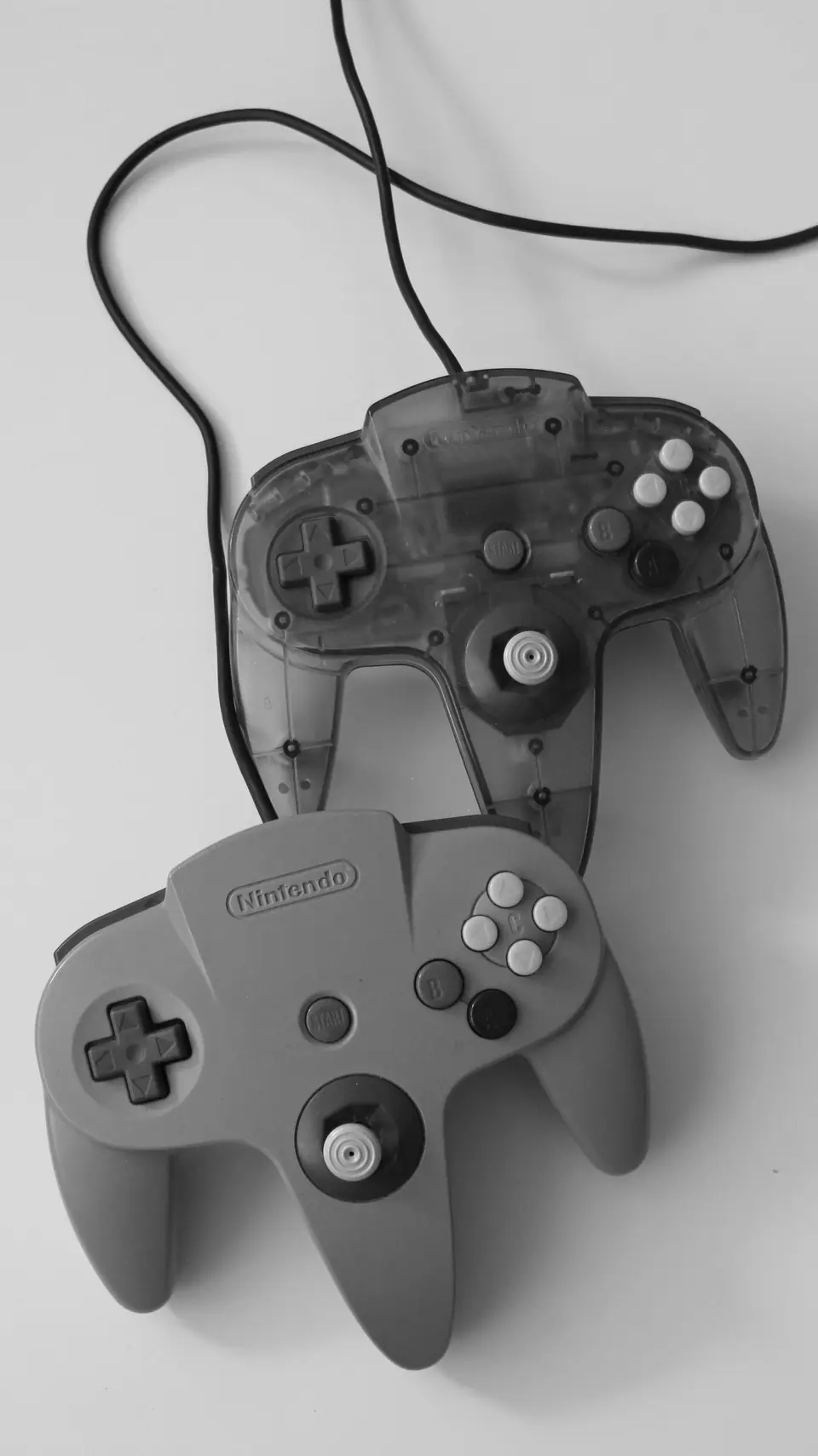
The Nintendo 64 lost the argument about storage and won the argument about the hand. Its thumbstick and its four controller ports still decide how we move through games and whom we play them with.
Written by CONTROL
This article runs 903 words and takes about four minutes to read.
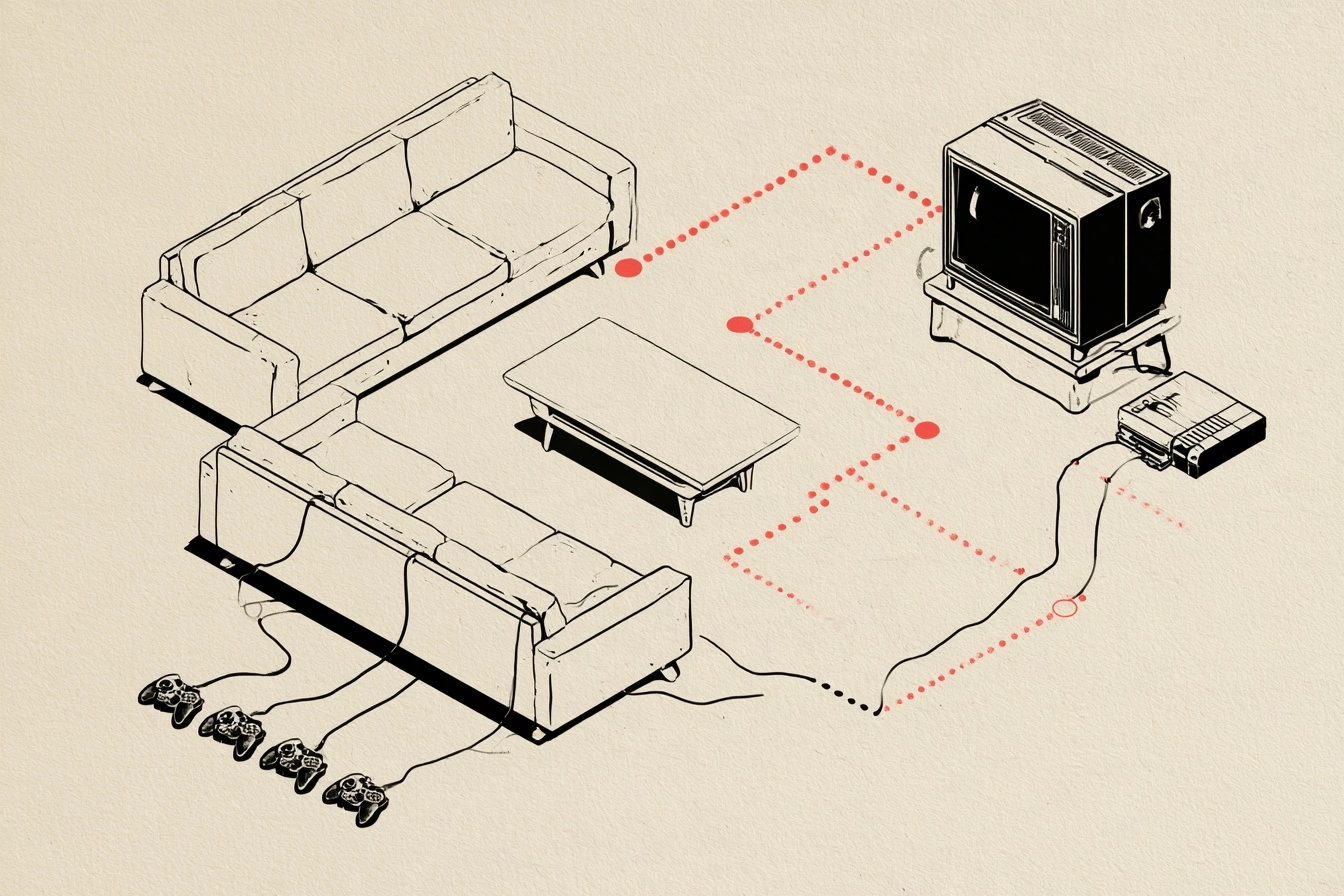
Most consoles are remembered for what they showed. The Nintendo 64 deserves to be remembered for what it let you do. Before it, console games were steered with a cross-shaped pad that knew eight directions and no speeds, so you were either moving or you were not. The N64 put a small stick in the middle of its controller, and Nintendo became the first manufacturer to include a thumbstick as a standard feature on its main controller. It also put four controller ports on the front of the machine. The first change gave the player degrees of intention, and the second gave the player company. The machine lost the commercial contest of its generation, and much of what it settled has never been reopened.
Project Reality
The machine began in 1993 as a partnership between Nintendo and Silicon Graphics, the California maker of high-end graphics workstations. Its code name was Project Reality, it was later shown as the Ultra 64, and it finally shipped as the Nintendo 64. It went on sale in Japan on June 23, 1996, and in North America on September 26, 1996. North America got exactly two launch games, Super Mario 64 and Pilotwings 64. Nintendo was betting that one of them would be enough, and it was right about which one.
A switch and a dial
Shigeru Miyamoto directed Super Mario 64, and accounts of its development say he built his 3D Mario less around the machine’s power than around its controller. The stick measured how far you pushed it, not merely which way. A slight push made Mario tiptoe, a firmer push made him walk and a full push made him run, in any of 360 degrees. That sounds like a refinement, and it is really the difference between a switch and a dial. With a switch, the game decides how fast you go. With a dial, you do.
The game hides 120 Power Stars across its courses and its castle, and it had sold nearly 12 million copies by 2015. Its lasting influence is harder to count. Most third-person games made since, with their analog runs and their cameras that swing around the hero, still work from the answers it gave on its first try.

Four ports
The NES and the Super NES each had two controller ports. The N64 had four, and Miyamoto has explained that it was the first console strong enough to run four-player split screen without serious slowdown. The game that proved the point arrived on August 25, 1997. It was GoldenEye 007, made by the British studio Rare and directed by Martin Hollis, and it was a licensed film game from which nobody expected much. It sold more than 8 million copies, became the third best-selling game on the system and won a BAFTA in 1998.
The mode that made it famous was nearly an afterthought. Steve Ellis, who joined the project after it was already underway, was mostly responsible for building the multiplayer, and it was added roughly six months before release. His colleague David Doak later described Ellis sitting in a room with code written for a single-player game and turning it into a multiplayer one. The multiplayer everyone remembers was added about six months before the game shipped, largely by one programmer.
The multiplayer everyone remembers was added about six months before the game shipped, largely by one programmer.
For a few years, four friends, four controllers and one television made up the whole social calendar of a great many dorm rooms. It was play that required everyone to be in the same place, and part of the pleasure was that you could see your opponents’ corners of the screen and they could see yours. Online play later made the arrangement look quaint, and it never quite replaced it.
The format that lost
The N64’s hardest opponent was a format. Nintendo kept cartridges, which loaded almost instantly, survived being dropped and were hard to copy, but they were expensive to make and small; the largest held 64 megabytes, while a CD held 650. Game makers noticed. Square had planned Final Fantasy VII for the Nintendo 64 and moved it to Sony’s PlayStation because of storage limits, and other studios followed. The N64 sold 32.93 million units in its lifetime, a respectable number that looks small next to the PlayStation’s 102.49 million. Nintendo won the couch and lost the argument about storage.
The part that wears out
There is an irony in the hardware. The part that gave the player control is the part most likely to fail. Inside each original controller, the stick pivots in a small plastic bowl that is softer than the stick itself, and years of play grind it into dust until the stick flops loosely at the center. Anyone buying original controllers should push each stick gently in every direction and let it go, because a good one snaps back firmly. Loose ones can be fixed with replacement stick assemblies, so the sensible purchase is a controller with a sound shell and cable, plus the cost of the repair.
Those who only want to play have easier options. Nintendo Switch Online’s Expansion Pack carries N64 games, and GoldenEye 007 joined it, and Xbox Game Pass, on January 27, 2023. The rule for playing it properly has not changed since 1997, and it asks for four controllers, four people and one screen.