
Field Notes
One good knife.
A block of eight dull knives is what buying looks like when nobody maintains anything. One chef’s knife, sharpened by the person who uses it, does nearly every job better and more safely.
Written by CONTROL
This article runs 965 words and takes about four minutes to read.
Most kitchens hold a block of eight or ten knives, and most cooks use one of them, dull, for everything. The block is a small portrait of how people tend to own things now. It arrived as a set, it was chosen for its range rather than its quality, and when its knives stopped cutting, the answer was to reach for another one instead of fixing the first. The alternative is older and simpler. Own one good chef’s knife, learn to keep it sharp yourself and use it for nearly every job. A sharp knife goes where it is pointed. A dull one skids off the skin of a tomato and finds a thumb.
Choosing one
Buy an eight-inch chef’s knife. It is long enough to cut through a large onion or a head of cabbage and short enough to control on an ordinary board. Go to a shop where you can hold several, and choose the one that feels balanced when you pinch the blade just ahead of the handle. That pinch grip, with the thumb and the side of the index finger on the steel, is how the knife should be held for most work.
Understand the two main traditions before you pay. Western kitchen knives, including the German style, have historically been sharpened closer to 20 degrees per side, on softer steel that tolerates rough use and needs frequent honing. Japanese knives often use harder steel that can hold an edge nearer 15 degrees, so they cut more cleanly and stay sharp longer but can chip against bone or a frozen block. The Japanese tradition has a long history behind it. When the Portuguese brought tobacco to Japan in the sixteenth century, smiths in Sakai, near Osaka, became known for the knives used to cut it, and during the Edo period the Tokugawa shogunate granted their work an official seal of quality. Either tradition will serve for decades. An inexpensive stamped knife with a plain handle, kept sharp, beats an expensive one kept dull.
Honing is not sharpening
The two words are often used interchangeably, but they describe different jobs. Honing does not remove metal. It pushes an edge that has rolled over during use back into line, which is why a knife that feels dull on Friday can feel sharp again after a few strokes. Sharpening removes metal to cut a new edge, and it is needed only a few times a year.
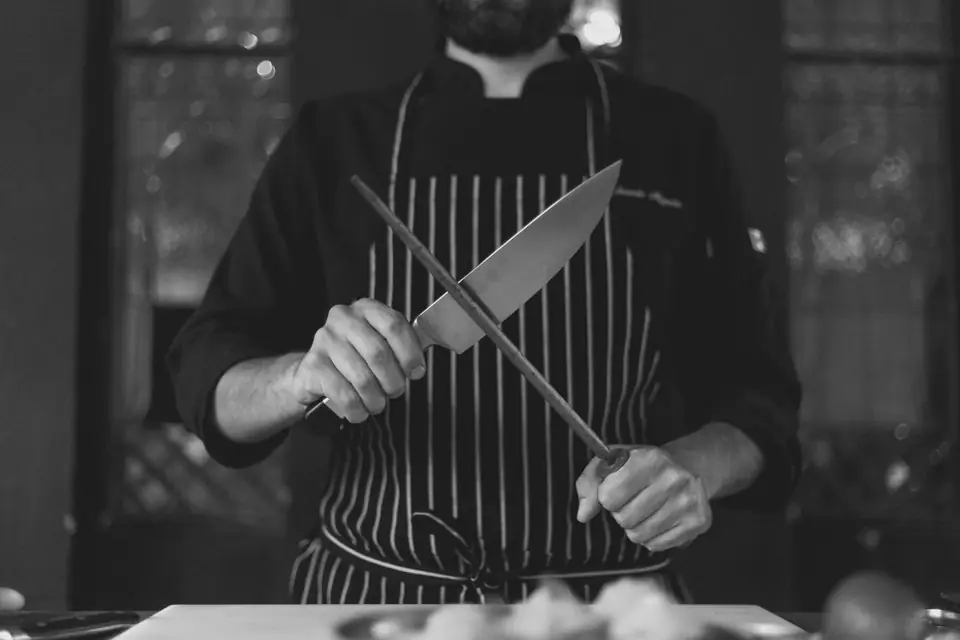
To hone, hold the rod upright with its tip on a folded towel, set the blade against it at roughly the angle of its edge and draw the knife down and toward you, heel to tip, alternating sides. Six light strokes a side is plenty. Use a steel rod on softer Western blades and a ceramic rod on harder Japanese steel.
The stone and the marker
When honing no longer brings the edge back, it needs new metal. Buy one combination water stone with a 1000-grit side for sharpening and a 6000-grit side for polishing. If the maker says it needs soaking, soak it until the bubbles stop, then set it on a damp towel so it cannot slide.
Lay the knife on the coarse side at its edge angle and push it across the stone in smooth strokes from heel to tip, with light pressure from two fingers of the other hand. Keep going on one side until you can feel a slight rough lip, called a burr, along the whole length of the opposite side. Then do the same on the other side. Switch to the fine side and repeat with ten lighter strokes a side to remove the burr, and finish with a few strokes on the rod.
Holding a steady angle is the hard part, and a permanent marker will show whether you managed it. Color the whole bevel before you start and look at it after a few strokes. If the ink is gone from the very edge but not the top of the bevel, the knife is too steep. If it is gone at the top but not at the edge, the knife is too flat. When the ink wears away evenly, you have found the angle, and the marker has taught you something no video can.
The ink shows you exactly where the stone is touching.
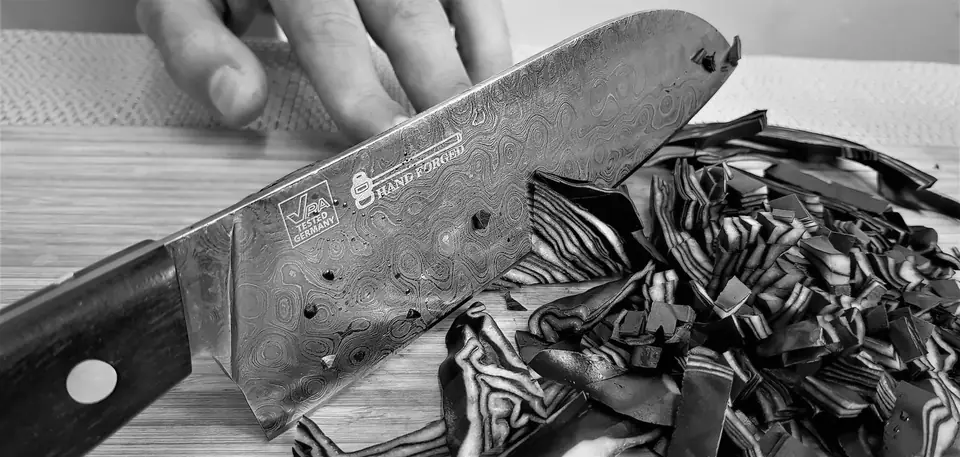
The marker works because it turns a feeling into evidence. The ink shows you exactly where the stone is touching. With practice, the hand learns the angle and the marker becomes optional.
How good knives are actually ruined
Few good knives are ruined by cooking. They are ruined by storage and washing. A knife loose in a drawer knocks against forks and can openers until the edge is chipped, and a dishwasher knocks it against the rack and bakes the handle. Wash the knife by hand straight after use, dry it at once and keep it on a wall-mounted magnetic strip, in a block or in a blade guard.
The board matters as much. Cut on wood or plastic, never on glass, stone or a ceramic plate, because hard surfaces flatten an edge in a few strokes. When you push chopped food across the board, turn the knife over and use the spine, so the edge stays off the wood.
Hone for a few seconds before each session and put the stone on the calendar for the first weekend of every fourth month. A blade that slices a sheet of printer paper cleanly is ready. There is a quiet satisfaction in that test, and it is not really about the paper. It is the pleasure of owning one thing completely, knowing how it works, how it fails and how to bring it back, which is a kind of control the block of eight never offered.