
Essay
Play one record at a time.
Streaming put every recording within reach and made it easy to hear none of them. A turntable set up properly in one room restores what the format was built around, which is twenty minutes of chosen, uninterrupted listening.
Written by CONTROL
This article runs 938 words and takes about four minutes to read.
On June 21, 1948, Columbia Records introduced the long-playing record at a press event at the Waldorf Astoria in New York. The disc turned at 33⅓ revolutions per minute, and a twelve-inch side played for a maximum of about 23 minutes. That number shaped popular music for decades. Albums were built in two halves, each about as long as a person will listen before getting up, and the act of getting up to turn the record over became part of the music.
Streaming removed the getting up. It also removed the choosing, since the next song arrives whether you asked for it or not, and the result for many listeners is a paradox: more music than any generation has had, and less of it actually heard. The case for a record player is not nostalgia, and it is not only sound, though a good one sounds very good. It is that the format enforces attention. You choose a side, you sit with it, and after twenty minutes the machine stops and asks you to choose again.
That argument holds only if the system does not demand attention of its own. Most people who give up on records do so not because they bought the wrong equipment but because they set up decent equipment badly, until the hum, the skipping and the thin sound become the thing they listen to.
Three boxes and a chair
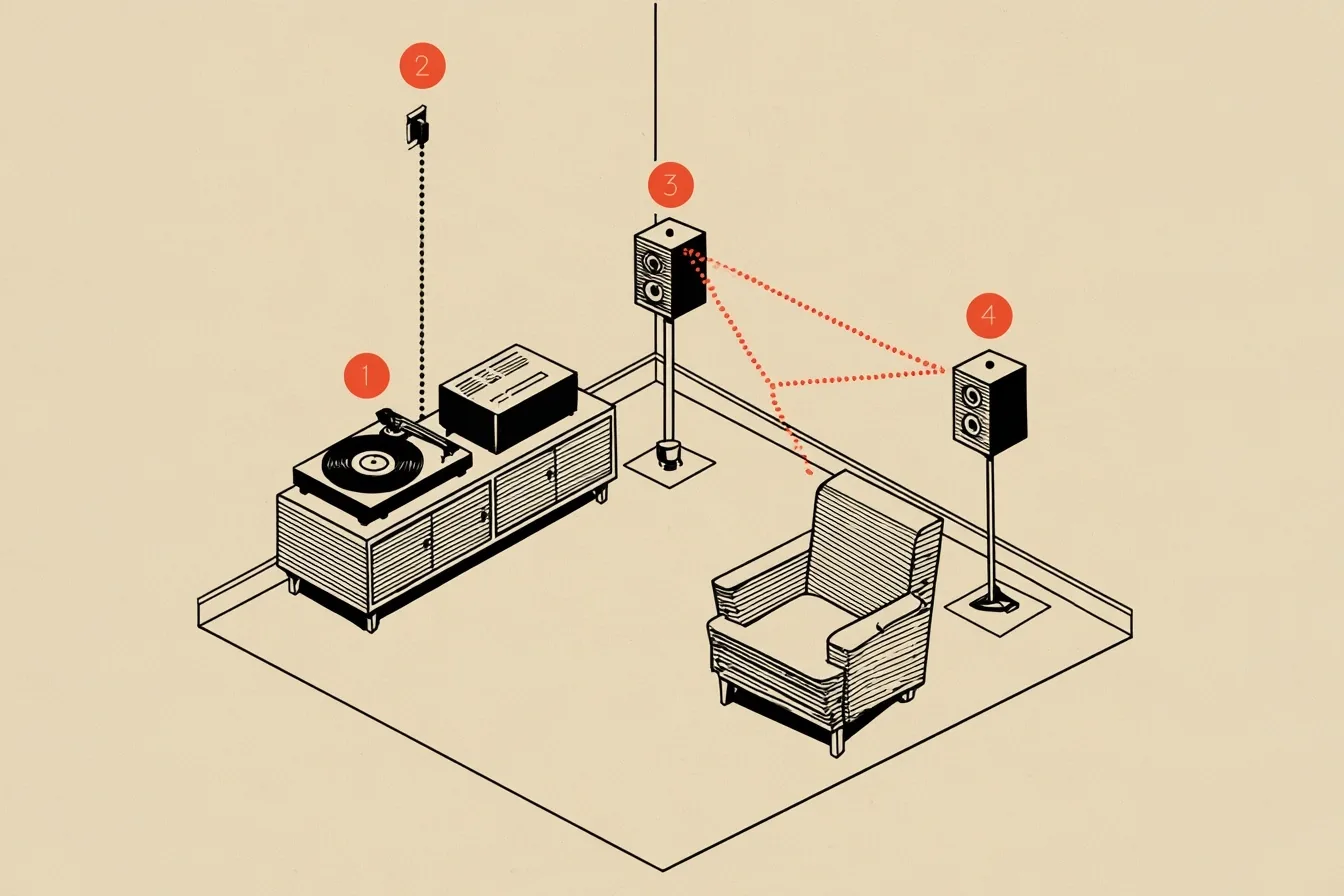
You need a turntable, an amplifier, a pair of speakers and a chair. Choose a belt-drive or direct-drive turntable from a maker with a long record of building them, with an adjustable counterweight, an anti-skate dial and a cartridge already fitted. Pair it with an integrated amplifier and bookshelf speakers on proper stands. The secondhand market is full of amplifiers and speakers built decades ago that still outperform new equipment at the same price. When you buy used, turn every knob and listen for crackle, confirm that both speakers play at the same volume and budget for a repair shop to clean and service an old amplifier before it goes into daily use.
The part nobody sees
A record is not a neutral copy of the music. It is cut with the bass turned down and the treble turned up, following an equalization curve that the Recording Industry Association of America standardized in the 1950s, because full bass would make the grooves too wide and quiet treble would sink beneath surface noise. A cartridge also puts out only a few thousandths of a volt. Before that signal reaches an ordinary input, something has to boost it and reverse the curve. That something is the phono stage, also called a phono preamp.
A record is not a neutral copy of the music.
It may live inside the amplifier behind an input marked PHONO, inside the turntable behind a switch or in a small box of its own. Use exactly one. A turntable with no phono stage, plugged into an ordinary line input, sounds faint and thin, and one that passes through two sounds loud and harsh. In both cases, most people blame the record.
If a thin separate wire comes out of the back of the turntable, it is a ground wire, and it belongs on the ground post of the amplifier or phono stage. Left loose, it produces a steady low hum beneath every record. Screwed down, it usually removes the hum for good, and it is the one repair in the hobby that costs nothing at all.
Two minutes with the tonearm
Put the turntable on a solid, level surface, and check it with a small bubble level on the platter. Keep it away from the speakers, because a turntable can pick up their vibration and feed it back through the system as a low howl. Pull the speakers at least a foot from the wall, set the tweeters at the height of your ears when you are seated and angle them toward the chair, so that you and the two speakers form a triangle with roughly equal sides. Move them an inch at a time and listen after each move.
Then spend the two minutes that most owners skip, on tracking force. If it is too light, the stylus skips and rattles in the groove. If it is too heavy, it wears both stylus and record faster than it should. Find the recommended force in the cartridge maker’s specifications. Take off the stylus guard, set the anti-skate dial to zero and turn the counterweight until the arm floats level in the air. Hold the weight still, turn only its numbered ring to zero, and then turn the whole weight toward the pivot until the ring reads the recommended figure. On many turntables you then set the anti-skate dial to the same number. An inexpensive digital stylus gauge will confirm the result to a tenth of a gram.
A shelf that keeps score
Before each side, sweep the record with a carbon-fiber brush while it spins, and clean the stylus with a small brush from back to front, never side to side. Store records upright, snug but not packed, away from radiators and sunlight.
Then buy slowly. A streaming library costs the same whether you love an album or never play it again, and so it records nothing about you. A shelf of records bought one at a time, each one chosen and paid for, is different. It is a list of the moments when you decided that something deserved twenty minutes. In ten years it will read like an autobiography, and unlike the streaming library, you will have heard all of it.