
History
Seven shapes.
A Soviet programmer built a nearly perfect puzzle, and businessmen from three continents fought over who could sell it. The history of Tetris is a lesson in how ideas escape the people who make them.
Written by CONTROL
This article runs 1,058 words and takes about five minutes to read.
Tetris has no story, no characters and no instructions worth reading, and across its many versions it had sold 520 million copies as of December 2024, according to The Tetris Company. It is as clear an example as games have of a design with nothing left to remove. Its history is the opposite: crowded, tangled and full of contracts. The game asks you to fit falling pieces neatly into place. The deal that carried it around the world was made of pieces that did not fit at all, and the man who designed it spent more than a decade without owning it.
A puzzle made of text
Alexey Pajitnov was a software engineer at the Dorodnitsyn Computing Centre of the Soviet Academy of Sciences in Moscow. By the most common account, in June 1984 he wrote the first version of Tetris in Pascal on an Electronika 60, a Soviet computer that could not display graphics, so the falling pieces were drawn with text characters. He started from pentominoes, the puzzle shapes made of five squares, and cut them down to the seven shapes that can be made from four. The name joins “tetra,” the Greek prefix for four, with tennis, his favorite sport.
The constraint made the game. A machine that could draw only letters and symbols left no room for scenery, so Pajitnov had nothing to work with but geometry and time. Seven shapes, one well and a rising speed turned out to be enough. Each piece is a small decision, and each mistake stays on the screen until you fix it. The game asks for exactly as much planning as you can manage and speeds up the moment you get comfortable, which is why it feels less like a toy than like a portrait of a busy week.
The disks that crossed the border
Pajitnov brought in two colleagues, Dmitry Pavlovsky and a 16-year-old named Vadim Gerasimov, to port the game to the IBM PC. Gerasimov added color and Pavlovsky added a scoreboard. Copies passed from hand to hand on floppy disks, first around Moscow and then across Eastern Europe. Nobody was selling it, because in the Soviet system there was no obvious way for a researcher to sell anything. By 1986 the game had reached a research institute in Budapest, Hungary, where a visitor from London saw it.
The visitor was Robert Stein of Andromeda Software. He sent a telex to Moscow asking for the rights, took a cautious reply from Pajitnov as a yes and began selling a license he did not yet hold. He sold it to Mirrorsoft in Britain, part of Robert Maxwell’s publishing empire, and to Spectrum HoloByte in America, and both released Tetris in January 1988. Mirrorsoft then passed console rights to Tengen, a subsidiary of Atari Games. The trouble was that the agreement Stein finally signed with Elorg, the Soviet state agency that handled foreign sales of software, covered computers and nothing else.
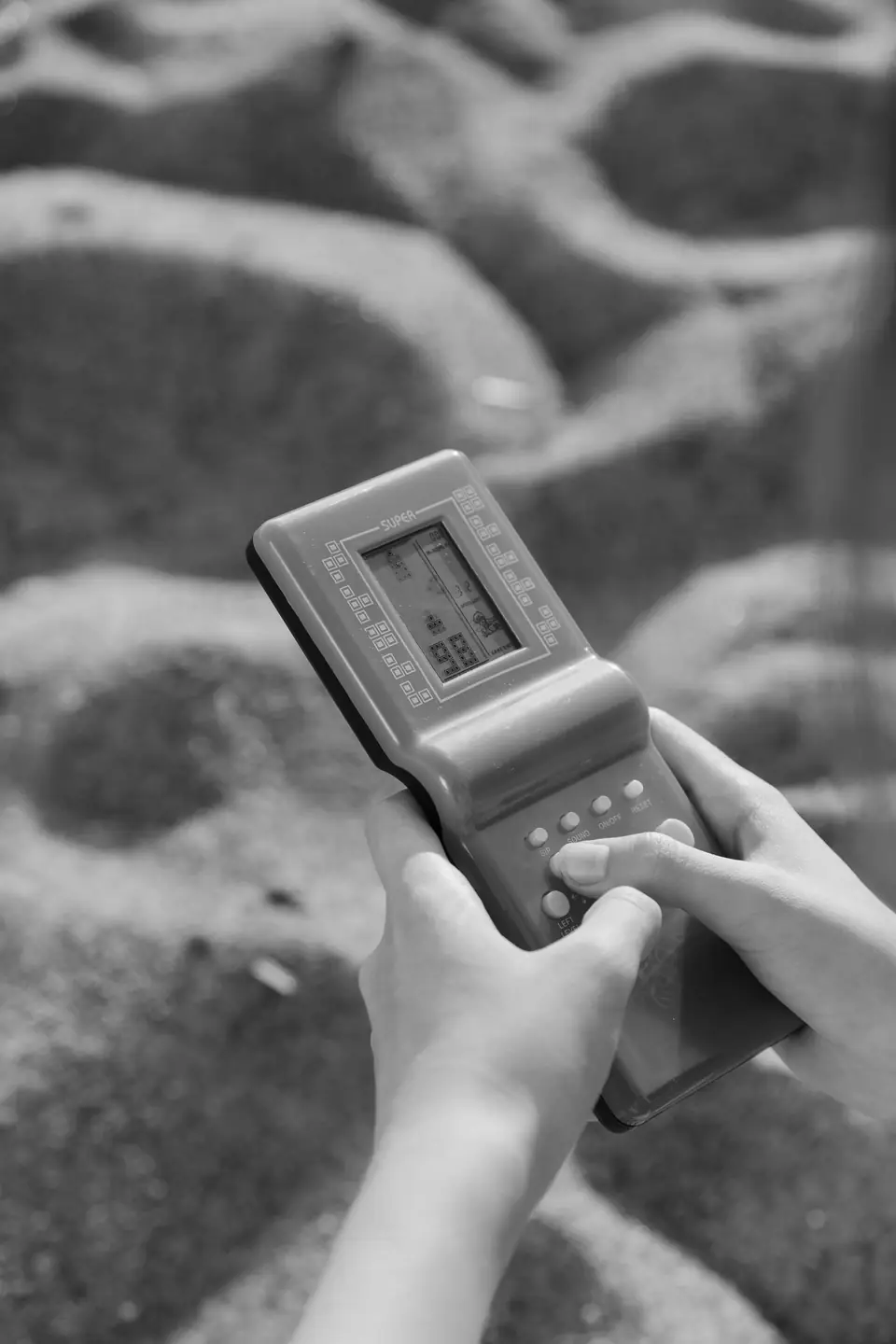
The game asks you to fit falling pieces neatly into place.
Moscow, February 1989
Henk Rogers, a Dutch-born game publisher based in Japan, flew to Moscow uninvited in February 1989 to ask Elorg for the handheld rights for Nintendo’s coming Game Boy. He showed Elorg’s director a Japanese Famicom Tetris cartridge, a console version the agency had never approved. Stein and Kevin Maxwell, Robert Maxwell’s son, were in Moscow at the same time. Rogers left with the handheld rights, and Nintendo soon secured the console rights as well.
There is a tidy version of this story in which a plain-spoken outsider beats two larger companies by showing up in person. It is partly true. The larger lesson is that Elorg, a state agency new to the Western games business, discovered in a single week how much its own property was worth, because three bidders were standing in its offices at once. The contracts that followed did more to decide the fate of Tetris than anything in its code.
Tengen believed it owned the console rights and was preparing its own Tetris for the NES. Nintendo sent cease-and-desist letters on March 31, 1989, and Tengen sued first. On June 22, 1989, Judge Fern M. Smith of the U.S. District Court for the Northern District of California granted Nintendo a preliminary injunction, and Tengen pulled its cartridge from the market. Less than six weeks later, on July 31, 1989, the Game Boy reached North America with Tetris in the box, and that version went on to sell 35 million copies.
The game comes home
For years, the game did not belong to the man who made it. The Computing Centre held the rights for ten years, and they returned to Pajitnov only when that term ran out at the end of 1995. He had moved to Seattle in 1991 with help from Rogers. In 1996 Elorg and Blue Planet Software, a company Rogers had founded the year before, formed The Tetris Company as an equal partnership to manage the game’s licensing, and the old fight over who could sell it finally had one answer.
It is tempting to read the story as a parable about the Soviet Union, and in part it is. A system that did not let individuals own ideas produced a brilliant idea and then had no way to hold on to it. But the Western side of the ledger is not much more flattering. Men who had never met Pajitnov sold and resold his work on the strength of a telex, and the question of who owned one of the most popular puzzles in the world was settled by lawyers and a federal judge in California. In both systems, the person with the least control over Tetris was the one who had invented it.
The game itself kept its own counsel through all of it. It still rewards the same few habits: keep the stack flat, leave one column open against a wall and wait for the long straight piece that clears four lines at once, a move called a tetris that scores more than any other. It is a game about making order from what you are given rather than what you would choose. Pajitnov, who waited more than a decade for his own work to come back to him, would have understood that better than most of the people who played it.