
History
The gray box.
In 1985 American stores wanted nothing to do with video games, so Nintendo disguised its console as a VCR and sold it with a robot. The machine’s most important part was a chip that decided which games it would agree to play, and that decision has been the business model of the industry ever since.
Written by CONTROL
This article runs 1,101 words and takes about five minutes to read.
Most people who owned a Nintendo Entertainment System remember the blinking. A cartridge went in, the power button went down, and instead of a title screen the television flashed and the red light on the console blinked on and off, about once a second, for as long as anyone cared to watch. Children blew into the cartridge, pushed it in again and hoped. Almost none of them knew what they were looking at. It was a conversation between two chips that had failed, and the console refusing, politely and repeatedly, to play.
That refusal is the real story of the NES. The machine is remembered for Super Mario Bros. and for bringing video games back from the dead after the crash of 1983, and it deserves both reputations. But the way it did the second thing was by taking control of what could run on it, and the blinking light was the visible edge of that control. Nearly every console since has been built on the same idea, and so have the app stores on our phones.
A disguise for a discredited product
Nintendo released the Family Computer, known as the Famicom, in Japan on July 15, 1983. It was red and white, it loaded cartridges from the top, and it had no lockout chip, so unlicensed games soon appeared. It was a hit at home. In America the timing could hardly have been worse, because the market for video games was collapsing that same year, and retailers had decided they wanted no more of it.
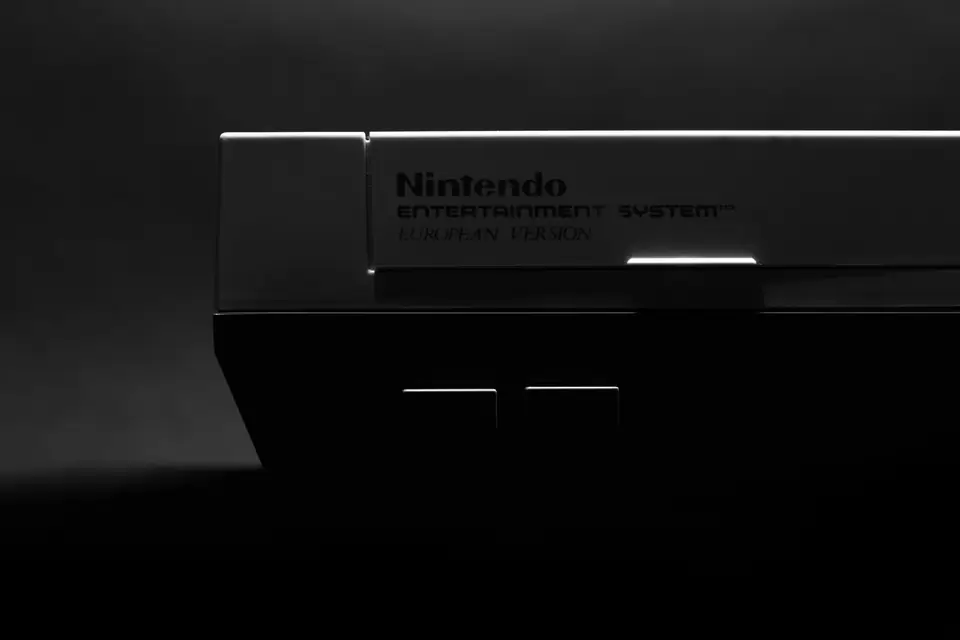
So Nintendo did not ship the Famicom. Designers Lance Barr and Don James gave the American machine a gray, boxy shell modeled on a videocassette recorder, with a door on the front where the cartridge slid in and pressed down like a tape. The company avoided calling it a video game console at all. It was the Nintendo Entertainment System, the main unit was the Control Deck, and the cartridges were Game Paks.
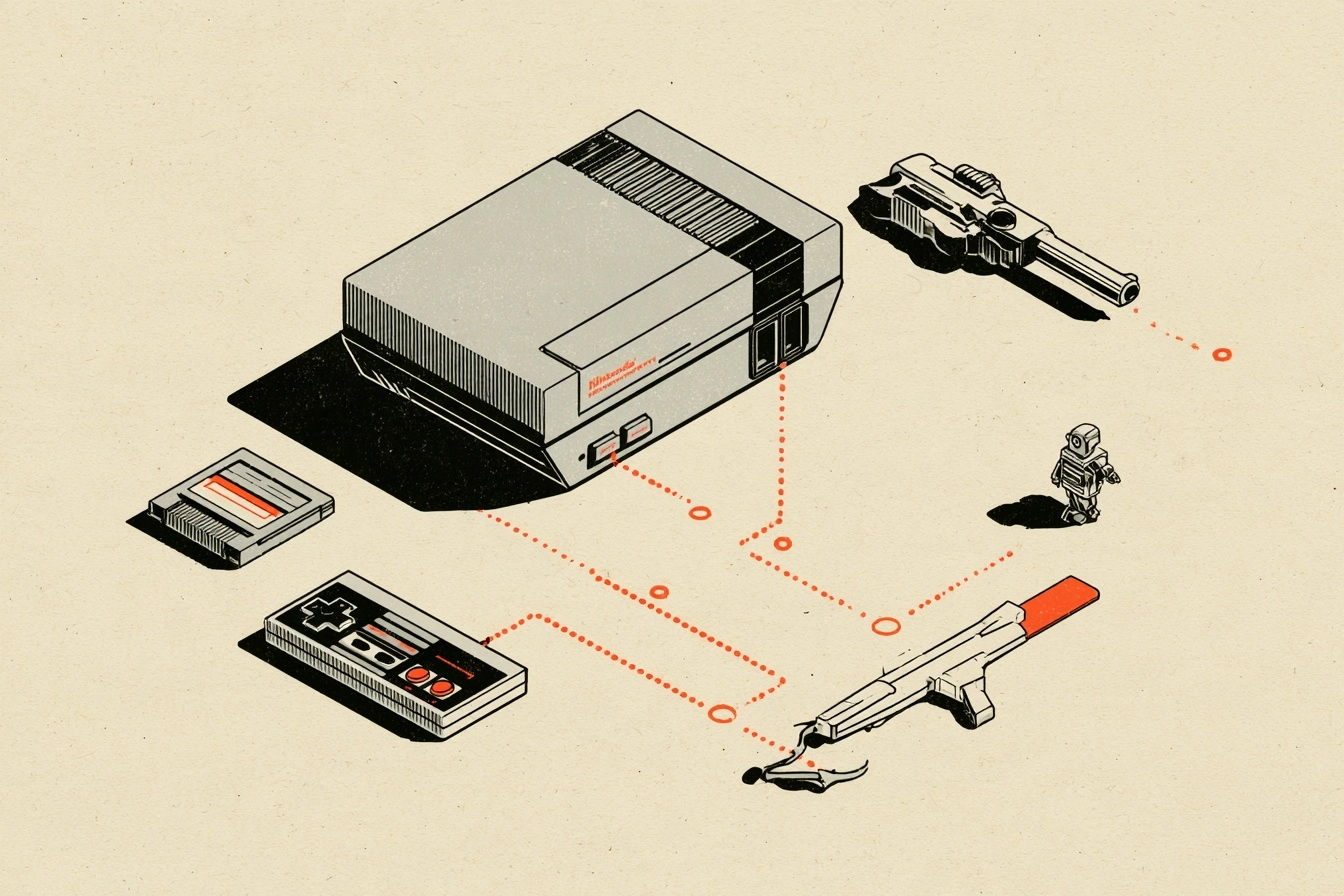
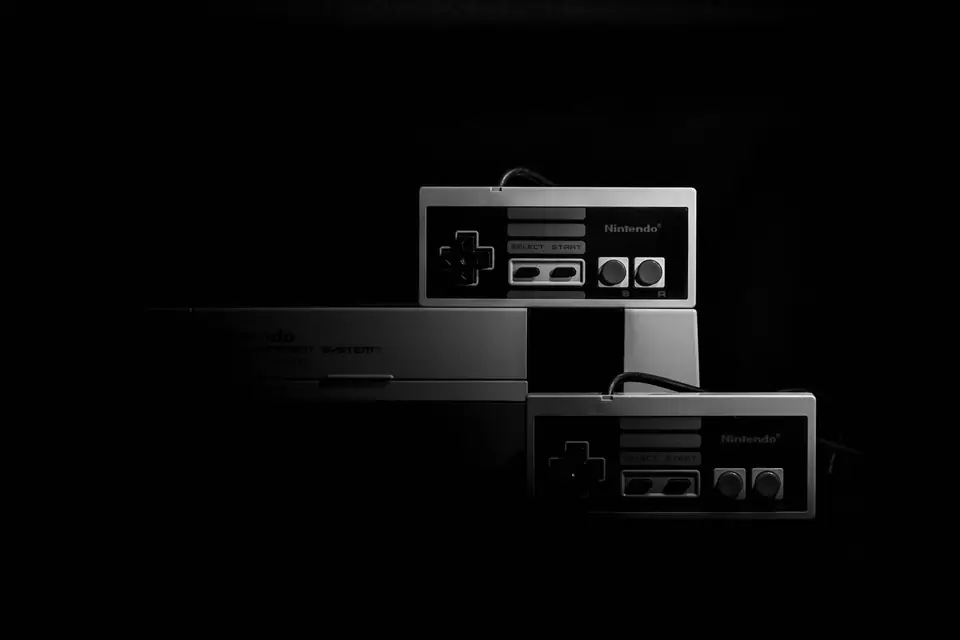
The NES went on sale in a test market in New York on October 18, 1985. The Deluxe Set came with the Control Deck, two controllers, the Zapper light gun, a robot called R.O.B. and two games, Gyromite and Duck Hunt. R.O.B., short for Robotic Operating Buddy, was designed by Gunpei Yokoi. It took its orders from flashes of light on the television screen, read by an optical sensor, the same principle the Zapper used. Its real job was to let Nintendo place the system in the toy aisle, next to Transformers and Voltron, rather than in the section of the store that buyers now associated with the crash.
Nintendo never asked stores to sell a video game. It asked them to sell a robot. R.O.B. did his job and then retired. Only two games, Gyromite and Stack-Up, ever used him, and once players found Super Mario Bros., nobody missed him. The NES went on sale across the country on September 27, 1986. By 1990 it was in about 30 percent of American households.
The lock
Nintendo had watched Atari lose control of its own console to a flood of poor games from outside companies, and it built the NES so that could not happen again. Inside every American and European console sat a lockout chip called the 10NES. A matching chip in each licensed cartridge had to answer it with the right handshake. If the answer did not come, the console reset itself about once a second, and the screen and the power light blinked in time.
The chip was a piece of engineering in the service of a contract. Outside publishers had to be licensed by Nintendo, could release only five games a year and had to order at least 10,000 cartridges at a time, paid in advance. Nintendo decided who made games for its machine, how many and on what schedule, and the chip made the decision stick.
Not everyone accepted the terms. Atari Games, through its Tengen label, obtained a copy of the chip’s program from the U.S. Copyright Office by falsely claiming it needed the code for a lawsuit, and built its own chip to get around the lock. Nintendo sued. The court held that reverse engineering a program to understand it could be a fair use, but that Tengen could not claim that protection for a copy it had obtained by deception, and it found that Tengen had infringed.
What the seal meant
The gold sunburst on every licensed box, the Official Nintendo Seal of Quality, looked like a promise that the game inside was good. It never was one. It meant the game was licensed by Nintendo. In August 2003 Nintendo of America dropped the words “of Quality,” explaining that consumers had come to understand that the seal did not say how good or bad a game was. The new wording called it assurance that a product was licensed or manufactured by Nintendo.
The change was more honest than the original, and it described the arrangement exactly. What the crash had taught Nintendo was that buyers wanted to trust the shelf. What Nintendo sold them was not quality, which no chip can guarantee, but permission, which a chip can enforce very well.
What Nintendo sold them was not quality, which no chip can guarantee, but permission, which a chip can enforce very well.
The lock outlives the reason
The lock was built to keep out bad games from strangers. Over the years it mostly kept out good games from their owners. The 10NES was sensitive, and when the 72-pin connector behind the front door wore out or collected dirt, the handshake failed on perfectly legitimate cartridges, and the console blinked. Blowing into the cartridge was folklore, and the moisture in a player’s breath only helped the pins corrode.
Nintendo itself eventually conceded the point. In October 1993 it released a redesigned, top-loading NES for $49.99, and the new model left out the lockout chip to avoid the reliability problems of the original. Hobbyists who still use the first model often disable the chip by cutting a single pin, pin 4, and a replacement connector usually takes care of the rest.
The gray box brought an industry back, and it did so by making a bargain that its owners never quite saw being made. They got a shelf they could trust. In return, the company that made the machine decided what the machine was allowed to do. The bargain has outlived the box, and it is worth noticing that when Nintendo redesigned the box for the last time, it took the lock out.