
Essay
Clear the desk.
A desk is a machine for paying attention, and most home desks have stopped doing the job. The fixes are old, cheap and physical, and they matter more now that the screen on top is built to keep you switching.
Written by CONTROL
This article runs 949 words and takes about four minutes to read.
The psychologist Gloria Mark, who studies attention at the University of California, Irvine, has spent two decades timing how long office workers look at one screen before switching to another. In 2004 her subjects averaged about two and a half minutes. In recent years the average has fallen to 47 seconds, with a median of 40, figures she set out in her 2023 book Attention Span. Other researchers who have repeated the work have found much the same thing.
Most advice about this problem concerns software: notifications, blockers and apps that promise to protect your time from other apps. This piece is about the furniture. A desk is the oldest tool we have for deciding where attention goes, and most home desks have quietly stopped doing that job. They become shelves. The chair becomes a coat rack, and the work drifts to the sofa, where the laptop sits on the knees and the rest of domestic life is within reach. The argument here is that a desk set up properly once, and reset every evening, does more for concentration than any app, because it changes what is in front of you before you have had to decide anything.
A surface with one job
Choose one desk and give it one job. It should be deep enough for the screen to sit an arm’s length away and wide enough for a keyboard, a notebook and a cup of coffee, with nothing else living on it. A drawer is useful. A hutch full of cubbies is not, because every cubby is a place for things to wait, and waiting things ask for attention every time the eye passes over them.
Spend the money on the chair before the desk. You will sit in it for thousands of hours, and a cheap one says so by the second week. Adjust it until your feet rest flat on the floor, your knees sit at about the height of your hips and your lower back meets the backrest, and then bring the screen to the chair rather than the other way around. A laptop on a bare desk forces a choice between a good position for the hands and a good position for the neck. Put it on a stand, add a separate keyboard and mouse, and the choice disappears.
The window belongs at your side
The Occupational Safety and Health Administration is unusually precise about the screen. It recommends a viewing distance of 20 to 40 inches, with the top of the monitor at or slightly below eye level. Most people sit too close and look too far down, which is how a shoulder ache begins.
OSHA is also precise about the window, and here the common instinct is wrong. Most people face the window, because a view feels like a reward. That puts bright light behind the screen and makes the eyes work harder, while a window at your back throws glare onto the glass. OSHA’s advice is to set the monitor at a right angle to the window. Turned sideways, the window lights the desk and leaves the screen alone.
Turned sideways, the window lights the desk and leaves the screen alone.
Add one lamp with a warm bulb for the evening, aimed at the desk rather than the screen. The American Optometric Association recommends the 20-20-20 rule: every 20 minutes, look at something 20 feet away for 20 seconds. A plant or a picture across the room gives the eyes somewhere to go, and it is the one thing in view that asks nothing of you.
Cables are a kind of noise
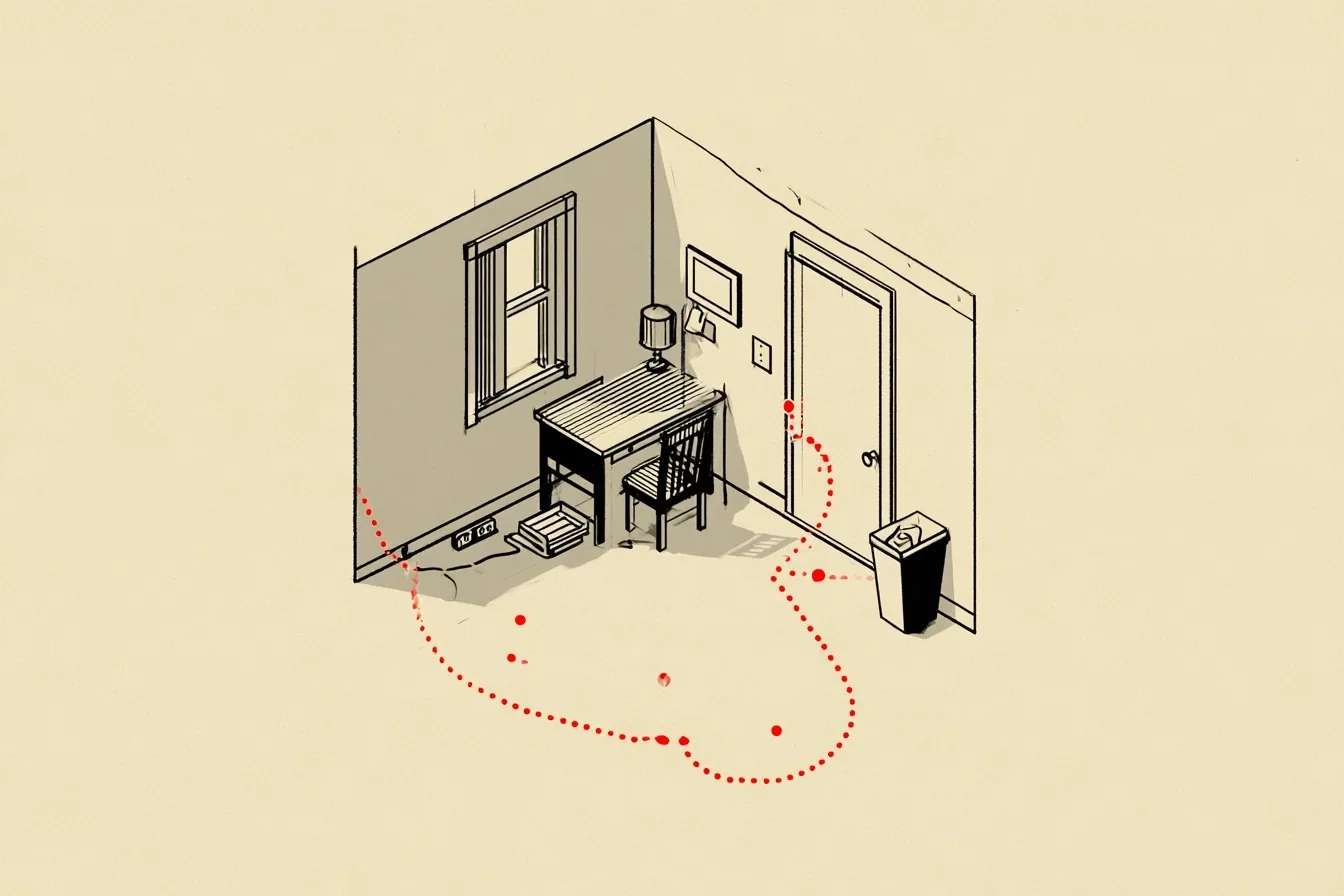
Cables look like a cosmetic problem, but they behave more like a sound that never stops. Screw one power strip to the underside of the desk toward the back and plug everything into it. Run the cords into a tray or basket beneath, bundle them with hook-and-loop ties and let a single cable drop to the wall. Label each plug with a strip of tape. The day you replace a monitor, you will be glad you did, and on every other day the tangle will simply be gone from the edge of your vision.
The pile wins by being small
The real enemy of a home office is the pile. It begins with one envelope you will deal with later, and within a month the desk has become a filing system that only you can read. The pile wins because every item in it is too small to be worth handling right now, and the same logic governs the open tabs on the screen. Neither is a failure of character. Both are what happens to any surface that is never cleared.
The answer is a five-minute reset at the end of each working day. Close every window on the screen. Put each piece of paper in one of three places: a tray for things to handle, a file for things to keep and the recycling for everything else. Write tomorrow’s first task on a card and leave it in the middle of the empty desk. Once a week, empty the tray entirely.
The reset is a small act of control over the next morning. If Mark is right, the average screen will pull your eyes away in under a minute, and nothing on your desk can change the software. What the desk can do is make the first minute of the day belong to you. You sit down, and there is one card, one task and nothing else within reach. That minute used to be called starting work. It is now the most contested minute of the day, and a clear desk is how you keep it.