
Essay
The garage decides.
An electric car changes the question from where you will buy fuel to where the car will sleep. Plan the charging before you choose the car, and the rest of the decision gets easy.
Written by CONTROL
This article runs 871 words and takes about four minutes to read.
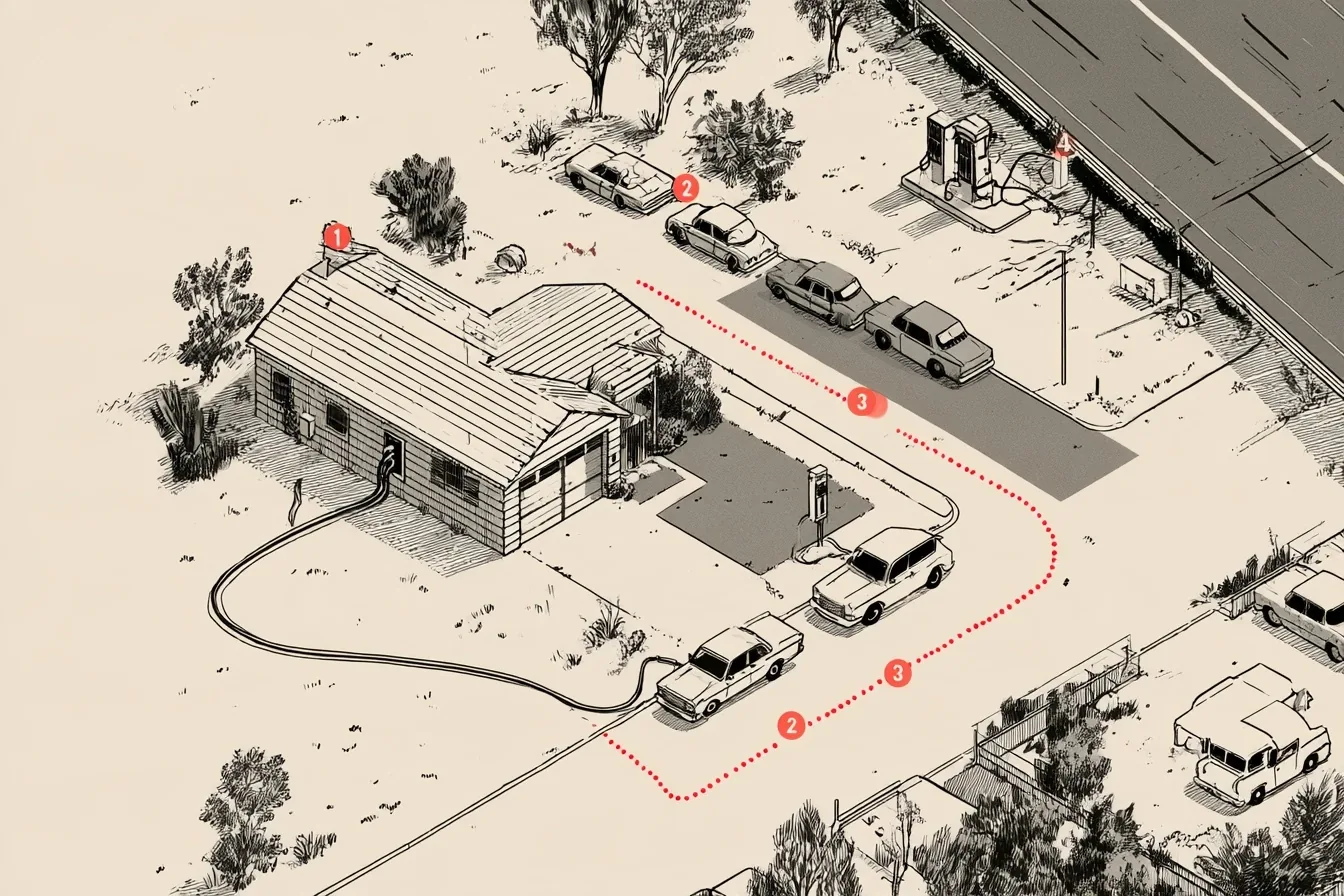
The urban planner Donald Shoup, working from federal travel survey data, calculated that the typical American car is driven for a little over an hour a day and parked the rest of the time, roughly 95 percent of its life. Later analysts checked the figure by other methods and found that it held up. The gasoline car made that fact easy to ignore, because where the car sat did not matter. It was filled somewhere else, in five minutes, at a station on the way.
An electric car turns the fact inside out. Parked time becomes fueling time, and the place where the car spends its nights decides more about owning one than the showroom does. That is the argument of this piece. For an electric car, the first purchase is not the car. It is the outlet.
For an electric car, the first purchase is not the car.

Three speeds of charging
There are three speeds of charging. Level 1 uses an ordinary 120-volt household outlet and adds about 2 to 5 miles of range per hour, which covers a short commute and little else. Level 2 uses a 240-volt circuit like the one behind a clothes dryer and adds about 10 to 30 miles per hour, enough to refill an ordinary day of driving overnight. DC fast charging happens at public stations, mostly along highways, and it is built for road trips.
If you own a house with a garage or a driveway, get a quote from a licensed electrician for a Level 2 circuit before you shop. Ask whether your panel has room for it and how far the cable must run, because distance drives the price as much as the charger does. A charger draws power for hours at a time, so the National Electrical Code treats it as a continuous load, and the circuit must be rated for 125 percent of the charger’s current. A charger that pulls 48 amps needs a 60-amp circuit, and one that pulls 32 amps needs a 40-amp circuit. Most wall chargers let the installer set a lower current, which can spare you a panel upgrade and still fill the car overnight. Ask your utility about a time-of-use rate as well, since many plans charge less for power used late at night.

Buy for the week you actually drive
Write down your real driving for two ordinary weeks before paying for range you will not use. It is easy to buy a car for the road trip you take twice a year and then drive it to work and the grocery store. Leave a margin for winter, because cold weather cuts range, and warm the cabin while the car is still plugged in so the heat comes from the wall rather than the battery. On a road trip, charge at a fast charger to about 80 percent and drive on, because charging slows sharply as the battery nears full.

When you do not own the driveway
The hard case is the renter, or anyone who parks on the street. For them, the overnight charge at home may simply not exist, and this is where an electric car can turn from a convenience into a chore. Prove the routine before you buy. Map the chargers within a ten-minute walk of home and of work. Ask your landlord or employer in writing whether a Level 2 outlet is possible. Then rent an electric car for a week and live the routine for real. If the week feels like a chore, keep the gas car for now, which is a perfectly sober answer.
A used car and a battery report
Price the car on its own terms. The federal tax credits for new and used electric cars ended on September 30, 2025, so leave them out of the math. Electric cars lose value like every other car, which makes a model a few years old a much better deal than a new one.
The battery is the most expensive part, so ask for a battery health report, sometimes called a state-of-health report, before you pay. Many makers cover the battery for eight years or 100,000 miles, but the terms differ, so confirm the coverage and whether it transfers to you. Check the plug, too. Many automakers are moving to the connector Tesla introduced, now standardized as SAE J3400, and older cars may need an adapter at some stations.
Once the car is home, set the daily charge limit to the level your manufacturer recommends, which for many cars is around 80 percent, and fill to 100 only before a long trip. Some batteries, especially the lithium iron phosphate type, are meant to be charged to full regularly, so read that page of the manual once. Rotate the tires on schedule, since the extra weight of an electric car can wear them faster.
None of this is exotic. It is the ordinary homework of a large purchase, done in a different order. The gas car taught a generation to think of fuel as an errand. The electric car makes it a fixture of the house, like the water heater, and it rewards the owner who plans for that before ever sitting in the driver’s seat.