

Reported
The right to repair.
For two decades manufacturers sold us the metal and kept the key to the software inside it. A run of state laws, new European rules and a federal settlement with John Deere have begun to settle who really owns a tractor or a phone.
Written by CONTROL
This article runs 1,269 words and takes about six minutes to read.
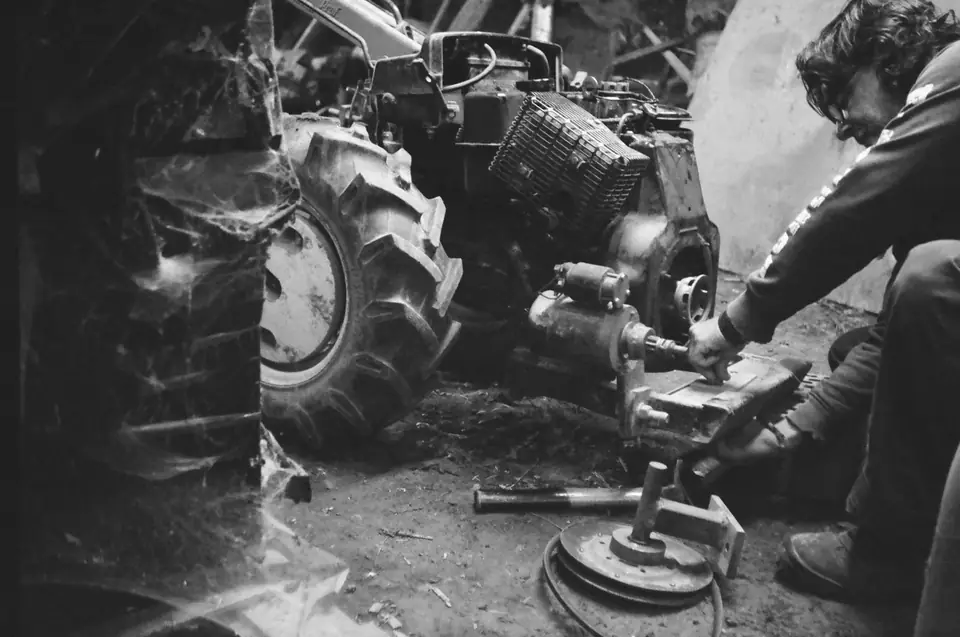
In March 2017 the technology site Motherboard reported that farmers in Nebraska were repairing their John Deere tractors with cracked software. The programs came from Eastern Europe, including Ukraine, and were traded on what one farmer described as a black market. They let a mechanic diagnose a broken component, recalibrate a tractor or reprogram its engine without waiting for a technician from an authorized dealer. The farmers were not trying to steal anything. They were trying to fix machines they had paid for, during a harvest that would not wait.
Part of the reason they needed pirated code was a license agreement. In October 2016, Motherboard reported, Deere had required customers to accept terms that forbade nearly all repair and modification of the software in their equipment. A farmer could own a tractor that cost as much as a house and still need permission to replace a sensor. That arrangement, repeated across phones, laptops, cars, appliances and wheelchairs, is what the right-to-repair movement set out to change. The movement’s real subject is not screwdrivers. It is the quiet division of ownership into two parts, the object you hold and the permissions the maker keeps.
The key in the maker’s pocket
The division rests on a few mechanisms. The first is legal. Section 1201 of the Digital Millennium Copyright Act, passed in 1998, makes it unlawful to circumvent the technical locks that protect copyrighted software, and nearly every modern machine runs on copyrighted software. The Librarian of Congress, advised by the U.S. Copyright Office, can grant exemptions every three years, and the process began carving out room for the repair of vehicles in 2015, but an exemption is a narrow permission rather than a right.
The second mechanism is technical. Manufacturers increasingly practice what is called parts pairing, in which a component’s serial number is matched to a particular device, so that a genuine replacement part taken from an identical machine may be rejected, disabled or flagged with a warning. The third is simple scarcity: manuals, diagnostic tools and spare parts sold only to authorized dealers. In May 2021 the Federal Trade Commission sent Congress a report titled Nixing the Fix, which examined the justifications manufacturers offered for these restrictions, including safety, security and liability, and found little evidence to support most of them.
Cars came first
The first decisive victory came from car owners. In November 2012, Massachusetts voters approved a ballot question requiring automakers to give owners and independent garages the same diagnostic and repair information they gave dealers, with almost 86 percent voting yes. When cars began sending their diagnostic data wirelessly, beyond the reach of that law, the state’s voters returned in 2020 and extended it to telematics with about 75 percent in favor. The margins mattered, because they showed that repair was not a partisan question. People simply did not like being told they could not fix their own things.
The states move
Electronics followed a decade later. Governor Kathy Hochul signed New York’s Digital Fair Repair Act on December 28, 2022, making it the first state law of its kind for consumer electronics. It applies to equipment made on or after July 1, 2023, and it exempts cars, medical devices and off-road equipment, including farm machinery. Minnesota passed a broader Digital Fair Repair Act in May 2023, which took effect on July 1, 2024 and covers equipment sold after July 1, 2021. The same spring, Colorado passed the first state law giving farmers and ranchers the right to repair agricultural equipment, which took effect on January 1, 2024.
California’s law, SB 244, signed on October 12, 2023, went further on duration. From July 1, 2024, makers of electronics and appliances must make parts, tools and documentation available for at least three years after the last date of manufacture for products priced between $50 and $99.99, and for at least seven years for products priced at $100 or more. The surprise was one of its supporters. Apple, which had opposed repair bills for years, backed it. In March 2024 Oregon became the first state to ban parts pairing, and Apple, which said it agreed with the vast majority of the bill, objected to that provision on security grounds. Washington became the eighth state with a repair law in May 2025, covering both consumer electronics and powered wheelchairs.
Apple’s change of position had been rehearsed in its own program. It announced Self Service Repair in November 2021 and opened it in April 2022, initially for the iPhone 12, the iPhone 13 and the third-generation iPhone SE. Customers could buy genuine parts and rent the tools for $49 a week. When the Verge tested it, Apple shipped a 79-pound repair kit to replace a battery that weighed 1.1 ounces. The program was real, and it was also a demonstration of how much control a company could keep while appearing to give some away.
Europe writes it into law
The European Union has moved more slowly and more comprehensively. Its Directive on the repair of goods, Directive (EU) 2024/1799, dated June 13, 2024, obliges manufacturers to offer repair for certain products, including washing machines, dishwashers, refrigerators, smartphones and tablets, at reasonable prices. Consumers who choose repair over replacement under warranty receive an extra year of legal guarantee. Member states were required to write the directive into national law by July 31, 2026, and an EU-wide online repair platform is due to follow.
Separate ecodesign rules for smartphones and tablets have applied since June 20, 2025. Manufacturers must supply key spare parts, such as batteries, cameras and screens, for seven years after a model leaves the market, provide operating system updates for at least five years, and build batteries that survive at least 800 charge cycles. Each device now carries a label with a repairability score, which turns a company’s attitude to repair into a letter grade on the box.

The movement’s real subject is not screwdrivers.
Deere settles
The tractor story reached its turning point this year. The Federal Trade Commission sued Deere in January 2025, alleging that it had illegally restricted farmers’ ability to repair their own equipment by keeping its software repair tools for authorized dealers. In April 2026 Deere agreed to pay $99 million to settle a separate class action brought on behalf of more than 200,000 farmers in federal court in Illinois. On July 8, 2026, the FTC and five states, Illinois, Arizona, Michigan, Minnesota and Wisconsin, announced a settlement of their own. For ten years Deere must give farmers and independent repair shops the repair resources it gives its dealers, including the ability to read, clear and reset fault codes and to reprogram electronic components, along with technical manuals.
What ownership means now
None of this makes anyone repair anything. Most people will still take a cracked phone to a shop, and many farmers will still call the dealer. What the laws restore is the option, and the option is what ownership used to mean. A thing you own is a thing you may open, alter, lend, fix or ruin without asking anyone. A thing whose working depends on a maker’s continuing permission is closer to a subscription, whatever the receipt says.
The generation that grew up blowing into cartridges and unscrewing the backs of remote controls learned that machines had insides and that the insides were theirs to look at. The right-to-repair laws are an attempt to put that assumption back into the code. The farmers in Nebraska were right about the principle. They should not have had to buy the answer from strangers on a forum to act on it.